
Understanding the Science Behind Safe Bottle Cleaning and Choosing the Right Method for Every Type of Residue
Part 1 — Why Bottles Get Dirty and How Baking Soda and Vinegar Actually Work
Introduction: Two Popular Cleaners, One Common Question
Open almost any bottle-care guide, and you'll quickly notice two ingredients appearing again and again: baking soda and white vinegar.
One article recommends filling your bottle with baking soda and warm water.
Another suggests soaking it in vinegar overnight.
Some videos even tell you to combine the two, creating an impressive fizz that looks like it's removing years of buildup in seconds.
It raises an obvious question:
Which cleaner actually works better?
The answer, surprisingly, isn't one or the other.
In fact, asking whether baking soda is better than vinegar is a bit like asking whether a sponge is better than soap.
They serve different purposes.
They solve different problems.
And choosing the wrong one may leave you disappointed—not because the cleaner failed, but because it wasn't designed for the type of residue inside your bottle.
A reusable stainless steel bottle encounters many different substances throughout its lifetime.
Morning coffee.
Afternoon tea.
Protein shakes after the gym.
Electrolyte drinks during workouts.
Fruit-infused water on weekends.
Each beverage leaves behind its own unique "fingerprint."
Some leave oils.
Some leave tannins.
Others leave minerals, sugars, or proteins.
Understanding these different residues is the first step toward choosing the right cleaning method.
The real question isn't:
"Which cleaner is stronger?"
It's:
"What exactly am I trying to remove?"
Why Do Stainless Steel Bottles Get Dirty?
Many people assume that if a bottle only contains beverages, it should stay relatively clean.
In reality, every drink leaves behind microscopic traces.
Some are visible.
Others affect smell or taste long before they become noticeable to the eye.
These residues accumulate gradually through daily use.
The process is completely normal.
Knowing what remains inside your bottle helps explain why different cleaning methods produce different results.
Coffee Oils
Coffee is one of the most chemically complex beverages in the world.
During roasting and brewing, natural oils are released from the beans.
These oils carry much of coffee's rich aroma.
Unfortunately, they also cling remarkably well to bottle walls, drinking spouts, silicone seals, and lids.
Unlike water, oils do not rinse away easily.
Over time they create lingering smells, especially in bottles used for coffee every day.
Coffee is primarily an odor problem, not a stain problem.
Tea Tannins
Tea behaves very differently.
Rather than oils, tea contains naturally occurring plant compounds known as tannins.
These polyphenols contribute to tea's color and slight astringency.
As tea repeatedly contacts the bottle's interior, tannins gradually bond to smooth surfaces.
Instead of creating strong odors, they slowly produce the familiar golden or brown discoloration many tea drinkers recognize.
Tea is primarily a stain problem, not an odor problem.
Mineral Deposits
Water itself can also leave residue.
In regions with hard water, dissolved minerals such as calcium and magnesium remain behind after water evaporates.
Over months, these deposits can form thin white or cloudy layers inside bottles.
Mineral buildup is especially common in kettles, coffee makers, and reusable drinkware used daily.
Unlike coffee oils or tea stains, mineral deposits respond best to mild acids.
Sugars
Fruit juice, flavored water, sports drinks, and sweetened teas all contain varying amounts of sugar.
Although sugar dissolves easily in water, dried sugar becomes sticky and attracts additional residue.
This sticky layer can also trap coffee oils, tea tannins, or dust, making bottles feel dirtier than they actually are.
Proteins
Milk-based coffee drinks, smoothies, and protein shakes introduce another challenge.
Proteins can dry onto bottle walls if left for long periods.
Combined with fats and sugars, they create stubborn residue that often requires prompt washing with warm water and dish soap.
Leaving protein-based beverages inside a bottle overnight makes cleaning significantly more difficult.
Different Residues Require Different Solutions
Imagine trying to remove cooking grease using only water.
It probably won't work very well.
Now imagine trying to dissolve mineral scale using cooking oil.
That won't work either.
Cleaning depends on chemistry.
Every residue has its own characteristics.
Every cleaning agent has its own strengths.
The most effective bottle maintenance routine is not about finding one miracle cleaner.
It's about matching the cleaner to the residue.
This is where baking soda and vinegar begin to reveal their unique roles.
How Baking Soda Cleans Your Bottle
Baking soda, or sodium bicarbonate, has been used in households for generations.
Its popularity comes from its versatility, safety, and gentle cleaning properties.
Unlike harsh chemical cleaners, baking soda works through several subtle mechanisms.
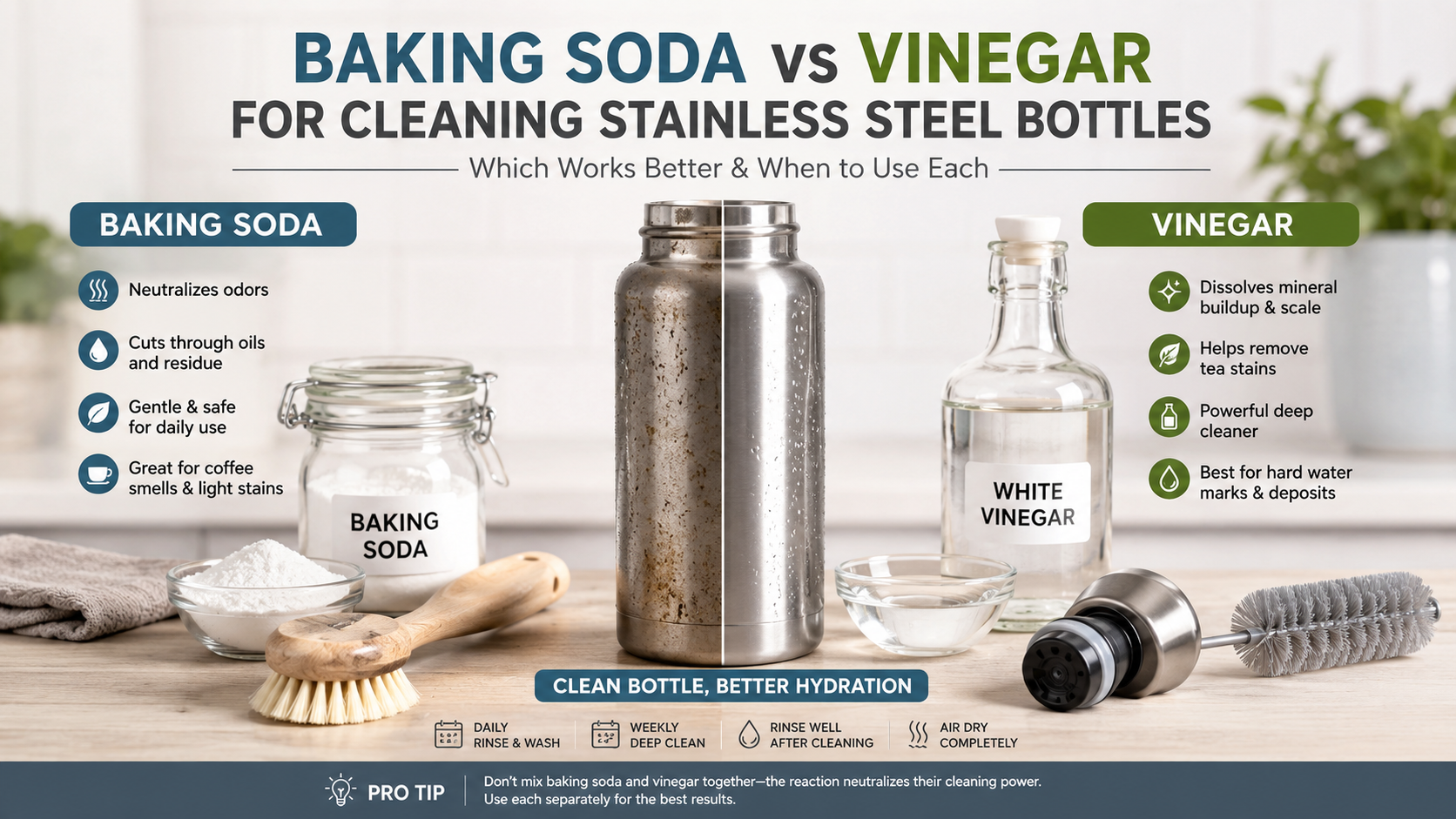
It Helps Neutralize Odors
One of baking soda's best-known abilities is reducing unpleasant smells.
Rather than masking odors with fragrance, it helps neutralize many odor-causing compounds.
This makes it especially useful for bottles that continue smelling like yesterday's coffee even after rinsing.
For reusable drinkware, baking soda excels at refreshing bottles used for coffee, tea, or flavored beverages.
It Helps Loosen Oils
Although baking soda is not a degreaser in the same way as dish soap, its mild alkalinity helps loosen oily residue.
Combined with warm water and gentle brushing, it can make coffee oils easier to remove.
This explains why baking soda is frequently recommended for coffee drinkers.
It Provides Gentle Mechanical Cleaning
Baking soda crystals are soft enough to avoid scratching stainless steel when dissolved properly.
Instead of acting as a harsh abrasive, they provide gentle cleaning action that helps lift light residue from smooth surfaces.
This makes baking soda suitable for regular maintenance.
It Is Safe for Routine Use
Food-grade baking soda is generally compatible with stainless steel, glass, ceramic-lined bottles, and many food-safe plastics.
Because it is relatively mild, it can be used periodically without causing unnecessary wear.
However, it should still be followed by thorough rinsing to remove any remaining powder.
When Is Baking Soda the Better Choice?
Baking soda performs particularly well when dealing with:
- Lingering coffee smells
- Mild beverage odors
- Light organic residue
- Routine maintenance
- Weekly deep cleaning
- Bottles used for coffee, tea, or flavored water
It is less effective against heavy mineral scale because mineral deposits respond better to acids than to mild alkalis.
How Vinegar Cleans Your Bottle
White vinegar works through an entirely different principle.
Unlike baking soda, vinegar is mildly acidic.
Its active ingredient, acetic acid, reacts with alkaline mineral deposits and helps dissolve substances that water alone cannot remove.
Understanding this difference explains why vinegar has become a trusted household cleaner for decades.
It Dissolves Mineral Scale
If you've ever noticed white deposits inside a kettle or around a faucet, you've seen mineral scale.
These deposits form when calcium and magnesium remain behind after water evaporates.
Acids dissolve these minerals effectively.
A diluted vinegar solution can gradually loosen these deposits without excessive scrubbing.
For bottles used in areas with hard water, vinegar is often the more effective option.
It Helps Remove Tea Deposits
Tea stains are caused largely by tannins and plant compounds.
Although vinegar does not magically erase every stain, its mild acidity helps loosen stubborn discoloration, particularly when combined with brushing.
Many tea drinkers find occasional vinegar soaks useful for restoring the bottle's appearance.
It Freshens Bottles After Heavy Use
Because vinegar helps dissolve certain residues left by repeated daily use, it works well as an occasional deep-cleaning treatment.
After soaking, washing the bottle with mild dish soap removes any remaining vinegar smell.
Is Vinegar Safe for Stainless Steel?
One of the most common concerns among bottle owners is whether vinegar damages stainless steel.
The short answer is:
Used correctly, diluted white vinegar is generally safe for high-quality food-grade stainless steel.
Problems are more likely to arise when bottles are exposed to strong acids for unnecessarily long periods.
Leaving concentrated vinegar inside a bottle for days serves little purpose and may unnecessarily expose seals or coatings to prolonged acidity.
Instead, short soaking sessions followed by thorough rinsing provide effective cleaning while minimizing unnecessary exposure.
Baking Soda and Vinegar Are Not Competitors
By now, a clear pattern begins to emerge.
Baking soda and vinegar are often compared because they are both inexpensive, widely available, and commonly found in household kitchens.
Yet their chemistry—and their purpose—are fundamentally different.
Baking soda shines when dealing with odors and light organic residue.
Vinegar excels at dissolving mineral deposits and helping loosen certain types of stains.
Neither replaces regular washing with warm water and mild dish soap.
Instead, they serve as complementary tools for periodic deep cleaning.
Understanding this distinction transforms bottle care from guesswork into informed maintenance.
Part 2 — Choosing the Right Cleaner for Every Situation and Building a Smarter Bottle Care Routine
Baking Soda vs. Vinegar: A Practical Side-by-Side Comparison
After understanding how each cleaner works, the next question becomes much easier:
Which one should you actually use?
The answer depends entirely on what is inside your bottle.
Neither baking soda nor vinegar is a universal solution. Instead, each performs best under specific conditions.
| Cleaning Situation | Baking Soda | White Vinegar |
|---|---|---|
| Coffee odors | ★★★★★ Excellent | ★★☆☆☆ Limited |
| Coffee oil residue | ★★★★☆ Good | ★★☆☆☆ Moderate |
| Tea tannin stains | ★★★☆☆ Moderate | ★★★★☆ Very Good |
| Hard water scale | ★☆☆☆☆ Poor | ★★★★★ Excellent |
| Mild daily maintenance | ★★★★☆ Good | ★★★☆☆ Good |
| Monthly deep cleaning | ★★★★☆ Excellent | ★★★★☆ Excellent |
| Stainless steel compatibility | Excellent | Excellent (when diluted and used briefly) |
| Silicone seal cleaning | Good | Good |
| Heavy mineral deposits | Limited | Excellent |
The comparison highlights a simple principle:
Choose the cleaner based on the residue—not on popularity.
Which Cleaner Works Best for Different Beverages?
Every drink leaves behind a different combination of compounds.
Understanding those differences makes bottle maintenance far more effective.
Morning Coffee
Coffee contains natural oils that carry rich aromas.
Over time these oils collect around bottle lids, drinking spouts, and silicone seals.
Best choice:
-
Warm water
-
Mild dish soap
-
Baking soda for occasional deodorizing
Black Tea
Tea leaves fewer lingering smells but more visible discoloration because of tannins.
Best choice:
-
Daily washing with dish soap
-
Occasional vinegar soak
-
Bottle brush for stubborn staining
Matcha
Unlike filtered tea, matcha contains finely ground tea leaves.
Small particles may settle at the bottom of bottles if not rinsed promptly.
Regular washing is usually sufficient.
Fruit-Infused Water
Fresh fruit introduces natural sugars and organic acids.
Although these rarely stain stainless steel permanently, they should not remain inside bottles overnight.
Dish soap remains the most effective everyday cleaner.
Protein Shakes
Protein drinks create one of the biggest cleaning challenges.
Proteins, fats, and carbohydrates combine into residue that hardens as it dries.
Neither baking soda nor vinegar should replace immediate washing after use.
Warm water and dish soap remain essential.
Sports and Electrolyte Drinks
Many sports drinks contain minerals, coloring agents, and sugars.
Routine washing prevents buildup, while vinegar may occasionally help remove mineral deposits if hard water is also involved.
Should You Mix Baking Soda and Vinegar?
Perhaps no bottle-cleaning advice is more widespread than combining baking soda and vinegar.
The bubbling reaction certainly looks impressive.
But does it actually clean better?
Not necessarily.
When baking soda (a mild alkali) reacts with vinegar (a mild acid), they neutralize each other.
The familiar fizz is simply carbon dioxide gas being released.
Although the bubbling may help loosen some loose debris through physical agitation, the reaction also reduces the individual cleaning strengths of both ingredients.
After the bubbling stops, what largely remains is water along with dissolved sodium acetate.
In other words:
The dramatic foam is not the same as stronger cleaning power.
For most reusable bottles, better results come from using each cleaner separately, according to the type of residue being removed.
Common Bottle Cleaning Mistakes
Many bottles lose their appearance—or even part of their performance—not because of age, but because of improper cleaning.
Here are several mistakes worth avoiding.
Leaving Coffee or Tea Overnight
The longer residue remains inside the bottle, the more opportunity oils and tannins have to attach to surfaces.
Even a simple rinse immediately after drinking can reduce future buildup.
Using Steel Wool
Steel wool may remove stains quickly, but it also scratches stainless steel.
Microscopic scratches create additional places for future residue to accumulate.
Soft bottle brushes provide a much safer long-term solution.
Using Bleach
Strong chlorine-based cleaners are unnecessary for routine bottle maintenance.
Some manufacturers specifically advise against prolonged exposure to bleach because it may affect stainless steel finishes or silicone components.
Always consult your bottle manufacturer's care instructions before using aggressive cleaning agents.
Forgetting the Lid
Many unpleasant odors originate from removable lids rather than the bottle itself.
Silicone seals, drinking valves, hinges, and threaded caps deserve the same attention as the bottle interior.
Storing Bottles While Wet
After washing, allow all components to dry completely before reassembly.
Good airflow helps reduce moisture retention inside hidden spaces.
Cleaning Different Bottle Materials
Although this article focuses on stainless steel, many households use several types of reusable drinkware.
The cleaning approach should be adjusted accordingly.
Stainless Steel
Ideal for both baking soda and occasional diluted vinegar.
Avoid abrasive pads.
Glass
Highly resistant to staining and odor.
Both baking soda and vinegar are generally suitable.
Ceramic-Lined Bottles
Use soft brushes and avoid aggressive scrubbing that may damage the coating.
Tritan™ and Other BPA-Free Plastics
Use warm water and mild dish soap for routine cleaning.
Occasional baking soda treatment can help reduce lingering odors.
Avoid prolonged exposure to strong acids unless recommended by the manufacturer.
Silicone Components
Remove seals whenever possible.
Wash separately and allow them to dry completely before reinstalling.
A Smarter Monthly Cleaning Routine
Rather than waiting until stains or odors become obvious, build a simple maintenance schedule.
After Every Use
- Empty remaining liquid.
- Rinse with warm water.
- Allow the bottle to air briefly before closing if immediate washing is not possible.
Every Evening
- Wash with warm water and mild dish soap.
- Clean the drinking spout and lid.
- Leave all components to dry completely.
Once Each Week
- Remove silicone seals.
- Clean bottle threads.
- Inspect for hidden residue around the lid.
Once Each Month
Choose your deep-cleaning method based on what your bottle actually needs.
If lingering odors remain after coffee use, a baking soda soak may be appropriate.
If tea stains or mineral deposits begin to appear, a diluted vinegar soak followed by gentle brushing may be more effective.
Routine maintenance is usually far easier than restoring a heavily neglected bottle.
Choosing a Bottle That Is Easier to Maintain
Good cleaning habits matter.
Good bottle design matters too.
Features that simplify long-term maintenance include:
- Wide-mouth openings for easier brushing.
- Food-grade 18/8 or 316 stainless steel interiors.
- Smooth interior surfaces with minimal crevices.
- Fully removable silicone seals.
- Leakproof lids that can be disassembled.
- Available replacement gaskets and lids.
- Durable exterior finishes suitable for everyday use.
These characteristics reduce hidden residue and make routine cleaning faster and more effective.
The Bigger Lesson: Good Bottle Care Is About Understanding Chemistry
Many online cleaning tips promise a single "best" solution.
In reality, bottle maintenance is rarely that simple.
Coffee oils behave differently from tea tannins.
Mineral scale behaves differently from protein residue.
Different residues require different cleaning strategies.
Baking soda and vinegar are valuable tools—not because one is universally better than the other, but because each addresses a different cleaning challenge.
Once you understand the chemistry behind the residue, choosing the right cleaner becomes straightforward.
Conclusion
Reusable stainless steel bottles are designed for years of daily use, accompanying everything from morning coffee to afternoon tea and post-workout hydration.
Over time, residue is inevitable.
What matters is not preventing every stain or every odor, but responding appropriately when they appear.
Warm water and mild dish soap should remain your foundation for everyday cleaning.
Baking soda is an excellent companion for removing lingering odors and light organic residue.
Diluted white vinegar is particularly effective against mineral deposits and helping loosen tea stains.
Neither cleaner replaces the other.
Together, they form a practical, inexpensive, and science-backed approach to maintaining reusable drinkware.
Understanding what you're cleaning—rather than simply reaching for the nearest household ingredient—helps your bottle stay cleaner, last longer, and continue delivering fresh-tasting drinks with every refill.
References
The following sources provide reliable background information on food-contact materials, beverage chemistry, cleaning science, and reusable drinkware care:
- American Cleaning Institute (ACI). Consumer guidance on household cleaning products, cleaning chemistry, and best practices for safe cleaning.
- U.S. Food & Drug Administration (FDA). Information on food-contact materials, food-safe practices, and consumer product safety.
- World Health Organization (WHO). Guidance on safe drinking-water handling and hygiene practices.
- International Organization for Standardization (ISO). Standards related to stainless steel, food-contact materials, and quality management.
- British Stainless Steel Association (BSSA). Technical guidance on stainless steel properties, corrosion resistance, and maintenance.
- Specialty Steel Industry of North America (SSINA). Educational resources on cleaning and maintaining stainless steel surfaces.
- Food Chemistry (Journal). Peer-reviewed research covering tea polyphenols, coffee compounds, oxidation, and food chemistry.
- Journal of Agricultural and Food Chemistry. Research on coffee oils, tea tannins, beverage composition, and interactions with food-contact surfaces.
- Critical Reviews in Food Science and Nutrition. Review articles on beverage chemistry, food safety, and cleaning-related topics.
- Tea & Herbal Association of Canada and the UK Tea & Infusions Association. Educational resources on tea composition, tannins, brewing, and beverage science.