
Introduction: Drinking Habits Are Cultural, Not Accidental
At first glance, drinking water seems like one of the most universal human behaviors. Every person, regardless of geography or background, needs hydration to survive. Yet, the way people drink—and what they choose to drink from—varies significantly across cultures.
In some parts of the world, people prefer ice-cold beverages throughout the day. In others, warm or hot water is the default choice. Some cultures emphasize continuous hydration, carrying large bottles wherever they go, while others treat drinking as a more structured, ritualized activity tied to meals or specific times of day.
These differences are not random.
They are shaped by a combination of climate, cultural beliefs, daily routines, and historical habits. More importantly, these factors directly influence the types of drinkware that become popular in each region.
This leads to a key insight:
Drinkware is not just a product category—it is a reflection of how people live, move, and think about hydration.
Understanding these patterns is essential not only for consumers making better choices, but also for brands designing products that align with real-world usage.
1. What Shapes Drinking Habits Around the World
Before comparing regions, it is important to understand the underlying forces that shape drinking behaviors globally.
1.1 Climate: The Foundation of Hydration Behavior
Climate is one of the most influential factors in determining how often, how much, and what people drink.
In hot and humid environments, such as Southeast Asia, the human body loses water more rapidly through perspiration. This creates a natural demand for frequent hydration and larger liquid intake.
In contrast, colder climates often encourage the consumption of warm beverages, not only for hydration but also for thermal comfort.
Over time, these physiological responses become embedded in cultural norms.
1.2 Cultural Beliefs: Health, Tradition, and Perception
Cultural beliefs play a powerful role in shaping drinking habits.
For example:
- In many East Asian cultures, warm water is believed to support digestion and overall health.
- In Western societies, cold beverages are widely accepted as refreshing and normal, even in non-hot conditions.
These beliefs influence not only what people drink, but also how they evaluate the quality of their drinkware.
1.3 Daily Lifestyle: Movement vs Stability
Lifestyle patterns significantly affect drinkware needs.
- In highly mobile societies, where commuting and outdoor activities are common, drinkware must be portable, durable, and easy to use on the go.
- In more stationary environments, such as offices or homes, users prioritize comfort, taste, and ease of use over portability.
1.4 Beverage Culture: Coffee, Tea, and Beyond
The dominant beverages in a region also shape drinking behavior.
- Coffee-driven cultures require drinkware that preserves flavor and temperature.
- Tea cultures often prioritize materials that enhance taste and ritual.
- Regions with strong sports or outdoor cultures demand hydration-focused solutions.
Conclusion of the Framework
These factors combine to form distinct drinking patterns.
Drinkware does not define habits—habits define drinkware.
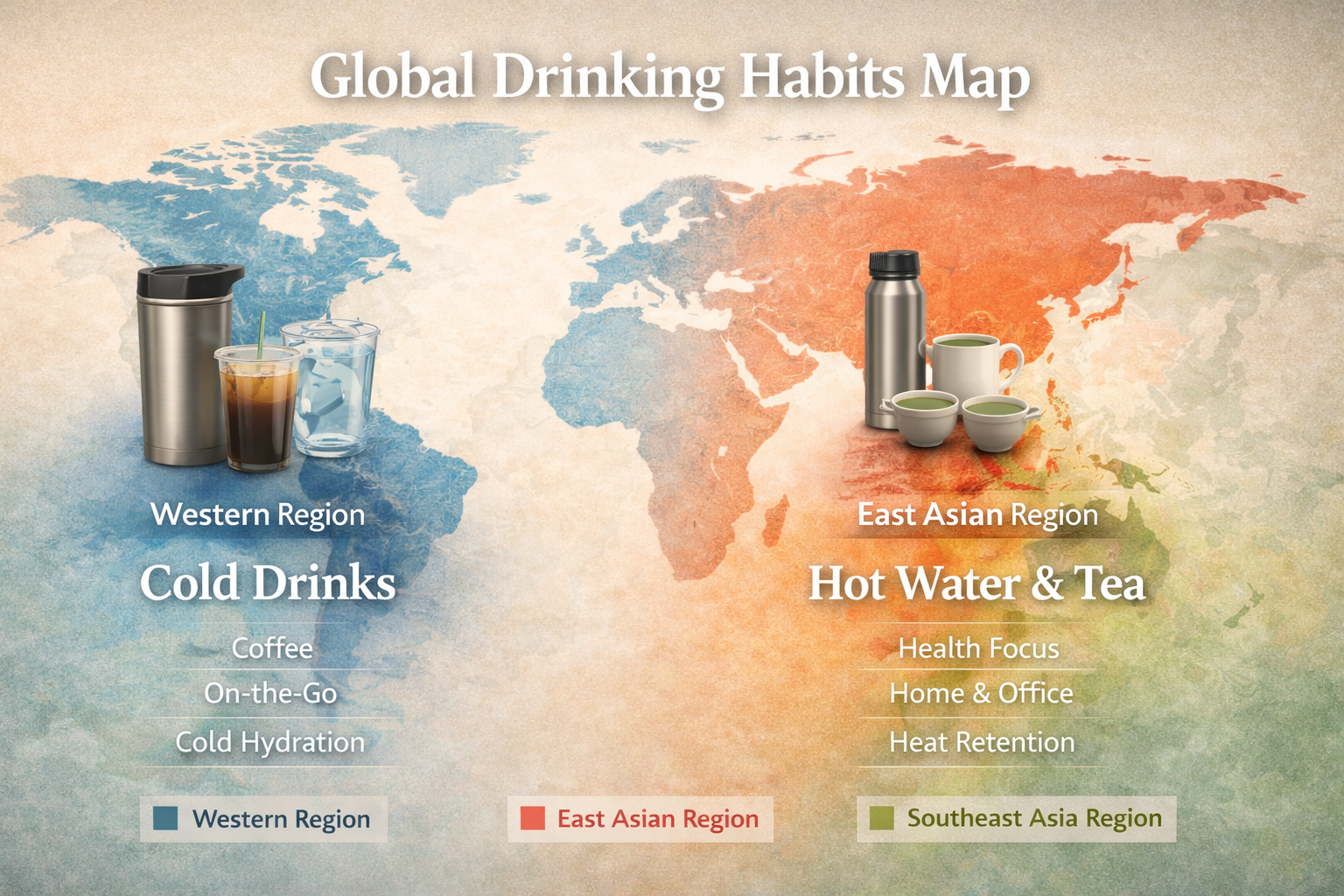
2. Western Drinking Habits: Mobility, Cold Beverages, and Coffee Culture
In Europe and North America, drinking habits are closely tied to modern, mobile lifestyles.
2.1 Cold Beverage as the Default
One of the defining characteristics of Western drinking culture is the widespread preference for cold beverages.
Ice water, iced coffee, and carbonated drinks are consumed regularly, even in moderate climates.
This preference is reinforced by:
- The availability of refrigeration
- Food service norms (e.g., ice in restaurants)
- Cultural associations with refreshment
2.2 Coffee as a Daily Anchor
Coffee plays a central role in daily routines.
For many individuals, hydration is not limited to water—it includes:
- Morning coffee
- Midday refills
- Takeaway drinks during commuting
This creates a strong demand for portable drinkware that supports hot beverages.
2.3 On-the-Go Lifestyle
Urban environments and commuting culture shape how people consume beverages.
- Drinks are often consumed while walking, driving, or working
- Convenience and accessibility are critical
2.4 Popular Drinkware Types in Western Markets
These habits have led to the rise of specific product categories:
- Insulated tumblers for takeaway coffee
- Large stainless steel bottles for all-day hydration
- Straw tumblers for cold beverages
Key Insight
Western drinkware prioritizes portability, convenience, and compatibility with both hot and cold beverages.
3. East Asian Drinking Habits: Warmth, Ritual, and Stability
In East Asia, including China, Japan, and Korea, drinking habits reflect a different set of priorities.
3.1 Preference for Warm and Hot Drinks
Warm water and tea are central to daily consumption.
This preference is rooted in long-standing cultural beliefs about health and balance.
3.2 Structured Drinking Patterns
Unlike continuous sipping habits seen elsewhere, drinking is often tied to specific moments:
- Morning routines
- Meal times
- Afternoon tea
3.3 Stable Usage Environments
Many users consume beverages in relatively stable settings:
- Offices
- Homes
- Cafés
This reduces the need for highly portable solutions.
3.4 Popular Drinkware Types in East Asia
As a result, the following products dominate:
- Vacuum flasks (insulated bottles) for hot water
- Ceramic mugs for tea and coffee
- Glass cups for clarity and taste purity
Key Insight
East Asian drinkware emphasizes temperature retention, taste experience, and cultural alignment.
4. Southeast Asian Drinking Habits: Heat, Hydration, and Versatility
Southeast Asia presents a unique combination of climate and lifestyle factors.
4.1 High Hydration Demand
Due to consistently high temperatures and humidity, hydration needs are elevated.
People tend to:
- Drink more frequently
- Carry water throughout the day
4.2 Diverse Beverage Consumption
In addition to water, popular drinks include:
- Iced tea
- Fruit juices
- Milk-based beverages
- Sweetened drinks
4.3 Active and Outdoor Lifestyles
Daily life often involves:
- Commuting
- Outdoor activities
- Social interactions
4.4 Popular Drinkware Types in Southeast Asia
These conditions drive demand for:
- Large-capacity bottles (1000ml and above)
- Lightweight plastic (Tritan) bottles
- Insulated bottles for cold retention
Key Insight
Southeast Asian drinkware must balance capacity, portability, and versatility across multiple beverage types.
5. How Drinking Habits Shape Drinkware Design
The relationship between culture and product design is direct and measurable.
5.1 Cold Beverage Cultures
Require:
- Strong insulation for cold retention
- Straw-based drinking systems
- Larger capacities
5.2 Hot Beverage Cultures
Require:
- Effective heat retention
- Materials that preserve taste
- Comfortable drinking interfaces
5.3 High-Frequency Hydration Cultures
Require:
- Lightweight materials
- Easy-to-clean designs
- Durable construction
Core Insight
Drinkware design is not universal—it is optimized for specific cultural and environmental conditions.
6. Why Certain Products Succeed in Specific Markets
Product success is often misunderstood as a function of quality or branding.
In reality, it is driven by alignment with user behavior.
Examples
- Large straw tumblers perform well in Western markets due to cold beverage habits
- Insulated flasks dominate East Asia due to hot water preferences
- Lightweight, high-capacity bottles succeed in Southeast Asia due to climate
Key Conclusion
The most successful products are not the most advanced—they are the most relevant.
7. Implications for Product Design and Branding
For companies operating globally, these insights are critical.
7.1 Avoiding a One-Size-Fits-All Approach
A single product design cannot effectively serve all markets.
7.2 Adapting to Regional Needs
Successful strategies include:
- Offering multiple capacities
- Providing material variations
- Designing for specific use cases
7.3 Building Around User Habits
Understanding how people actually drink is more important than introducing new features.
8. The Future: Global Convergence vs Local Identity
As globalization increases, drinking habits are beginning to overlap.
8.1 Global Trends
- Increased awareness of hydration
- Growing use of reusable drinkware
- Influence of social media on product adoption
8.2 Persistent Local Differences
However, certain factors remain unchanged:
- Climate
- Cultural beliefs
- Daily routines
Final Insight
The future of drinkware lies in balancing global trends with local relevance.
9. Key Takeaways
- Drinking habits vary significantly across cultures
- Climate, culture, and lifestyle shape hydration behavior
- Drinkware design must align with these habits
- Product success depends on relevance, not complexity
- Localization is essential in a global market
Conclusion: Understanding Habits Is the Key to Better Design
Drinkware may appear simple, but it sits at the intersection of human behavior, environment, and culture.
A bottle is not just a container—it is part of a daily system.
When design aligns with how people actually live, products become intuitive and widely adopted. When it does not, even the most advanced features fail to resonate.
The future of drinkware is not about innovation alone—it is about understanding people.
References & Supporting Sources
This article is informed by research and industry insights from:
- World Health Organization (WHO) – Hydration and climate impact studies
- National Institutes of Health (NIH) – Fluid intake and behavior research
- Euromonitor International – Global consumer behavior reports
- Statista – Beverage consumption trends by region
- Journal of Nutrition – Cultural influences on hydration
- Food and Agriculture Organization (FAO) – Regional dietary patterns
- Industry reports on reusable drinkware market trends