
How Everyday Rituals Grow With Us and Quietly Shape a Meaningful Life
Introduction: We Don't Outgrow Rituals—We Simply Create New Ones
When we think about rituals, it's easy to picture a morning routine.
A cup of coffee before work.
A walk after breakfast.
Reading a few pages before bed.
But rituals are much more than habits tied to a particular time of day.
They are the quiet rhythms that accompany us throughout life.
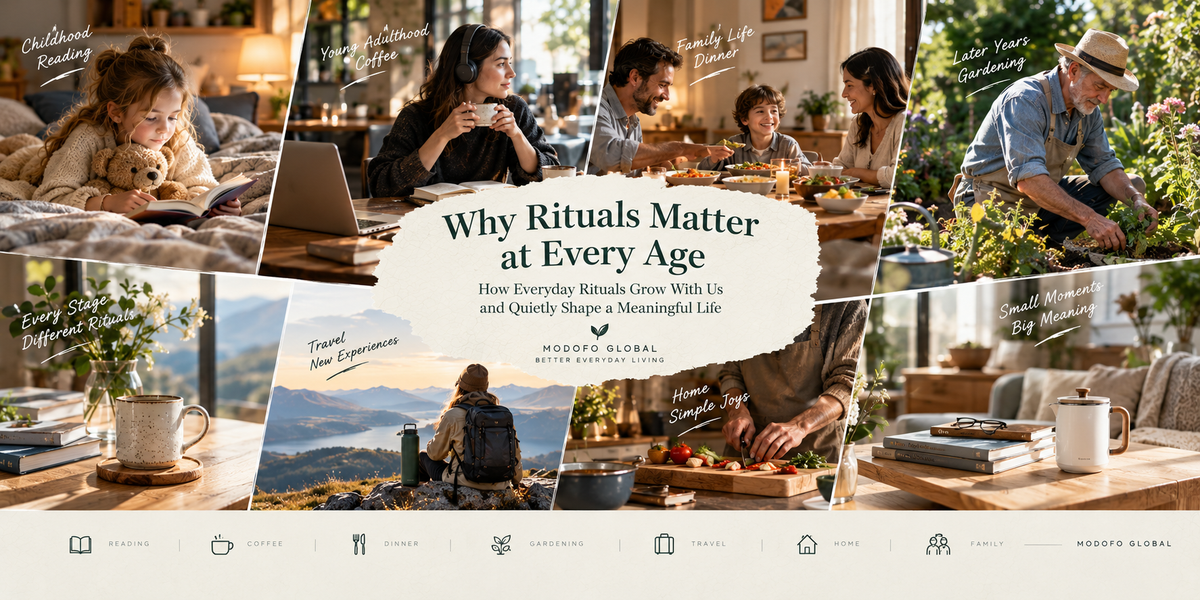
As children, we look forward to bedtime stories and weekend pancakes.
As young adults, we create rituals of our own—our favorite café, an evening run, or a notebook that captures new ideas.
Later, family dinners, weekend markets, and shared celebrations become the moments that hold everyone together.
And in later years, tending a garden, brewing tea, or taking a slow morning walk often becomes a source of peace.
Life changes constantly.
Our routines evolve.
Our priorities shift.
Yet every stage of life creates its own rituals.
Perhaps that is why we rarely remember life only through its biggest milestones.
We remember the small moments we returned to, again and again.
Childhood Begins with Small Rituals
Many of our earliest memories are built around repeated moments rather than extraordinary events.
A bedtime story read every evening.
Hot chocolate on rainy afternoons.
Saturday mornings at the local park.
Helping bake cookies before the holidays.
A lunchbox prepared with care.
These experiences may seem ordinary to adults.
To children, they become anchors.
They create a sense of comfort, belonging, and security.
Children rarely remember every ordinary day.
They remember the moments that happened often enough to become part of who they were.
The ritual itself becomes the memory.
Growing Up Means Creating Rituals of Our Own
As we become more independent, we begin choosing the rituals that reflect our own identity.
The first coffee brewed in a new apartment.
A weekend visit to the neighborhood bookstore.
Morning workouts before work.
A favorite playlist during the commute.
Traveling to the same place every autumn.
Writing in a journal before bed.
These moments aren't inherited.
They're created.
They become small promises we make to ourselves.
A way to slow down in a busy world.
A way to create stability even when everything else feels uncertain.
Personal rituals remind us that adulthood isn't only about responsibility.
It's also about intentionally creating a life that feels like our own.
Family Life Is Built Through Shared Rituals
Families are often remembered through traditions, but traditions begin with simple rituals.
Dinner around the table every evening.
Sunday breakfasts.
Movie nights with homemade popcorn.
Walking together after dinner.
Baking holiday treats every winter.
Picnics in the park when spring arrives.
None of these moments need to be elaborate.
Their power comes from repetition.
Week after week.
Year after year.
Families are rarely held together by grand celebrations alone.
They are strengthened by the ordinary moments people continue to share.
These rituals become part of a family's story, quietly connecting generations through everyday life.
Every Stage of Life Brings a New Rhythm
As life changes, our rituals naturally change with it.
A slower morning becomes more meaningful than a rushed schedule.
Gardening replaces hurried commutes.
Tea becomes a quiet afternoon pause.
Reading becomes an evening companion.
A walk through the neighborhood becomes a daily opportunity to notice the changing seasons.
Life doesn't become smaller as we grow older.
It often becomes deeper.
We begin appreciating experiences that once felt too ordinary to notice.
The beauty of later life is not found in doing less.
It is found in noticing more.
Rituals Give Ordinary Days Meaning
A cup of coffee is never just coffee.
A family dinner is never simply a meal.
An afternoon walk is more than exercise.
These repeated experiences carry emotional meaning because they happen again and again.
They create rhythm.
Comfort.
Familiarity.
Over time, rituals transform ordinary activities into meaningful moments.
They remind us to pause.
To connect.
To appreciate what already exists.
This is why some of the happiest people often speak not about extraordinary adventures, but about the small moments that shape everyday life.
The Objects Around Us Quietly Become Part of Our Rituals
Think about the objects you use almost every day.
A favorite mug waiting beside the coffee machine.
A reusable bottle that joins every commute and weekend adventure.
A notebook filled with ideas collected over the years.
A teapot placed on the table during conversations with family.
A backpack that has traveled across cities and seasons.
These objects rarely become memorable because they are expensive.
They become meaningful because they are present.
They accompany us through thousands of ordinary moments.
Eventually, they stop feeling like products.
They become trusted companions in the rituals that define our lives.
The best everyday objects don't interrupt our routines.
They quietly support them.
Rituals Connect Generations
Many family traditions begin with a simple habit repeated over time.
A grandmother's recipe prepared every holiday.
Fresh bread shared on Sunday mornings.
Tea served every afternoon.
A yearly camping trip.
Decorating the home together before celebrations.
Reading the same storybook to each new generation.
These rituals carry more than practical value.
They pass down memories.
Values.
Stories.
They remind us that belonging is built through shared experiences rather than perfect occasions.
Every family has its own rituals.
Together, they become part of its identity.
In a Digital World, Rituals Keep Us Human
Modern technology helps us move faster than ever before.
We communicate instantly.
Work remotely.
Access information within seconds.
Yet despite these conveniences, many people feel increasingly drawn toward slower, more intentional experiences.
Cooking together.
Sharing coffee.
Walking without a destination.
Gardening.
Writing by hand.
Talking without checking a phone.
Technology helps us organize our lives.
Rituals help us experience them.
One improves efficiency.
The other gives life meaning.
Perhaps that is why rituals feel more valuable today than ever before.
In a world filled with constant change, they remind us what remains beautifully human.
The MODOFO GLOBAL Philosophy
At MODOFO GLOBAL, we believe the best everyday products are never the center of attention.
Instead, they quietly become part of the rituals people return to throughout life.
Morning coffee before the day begins.
Lunch shared with colleagues.
Weekend markets with family.
Tea on a rainy afternoon.
A walk through the park.
Dinner around the table.
A road trip with friends.
These moments may look different from one person to another, but they all share something in common.
They happen again and again.
Our philosophy of Better Everyday Living is rooted in supporting these everyday rituals with thoughtfully designed essentials that move naturally through every stage of life.
Not because they are extraordinary.
But because they are always there when the moment matters.
Conclusion: A Beautiful Life Is Built One Ritual at a Time
Life is rarely defined by a single extraordinary event.
Instead, it is shaped by countless ordinary moments repeated with care.
The bedtime story.
The first cup of coffee.
The family dinner.
The weekend market.
The afternoon tea.
The evening walk.
These rituals change as we grow, reflecting who we are and who we are becoming.
They provide rhythm during busy seasons.
Comfort during uncertain times.
Connection across generations.
Perhaps that is why rituals matter at every age.
Not because they make life more complicated.
But because they help us notice the beauty already present in everyday living.
In the end, we do not remember life as one continuous story.
We remember it as thousands of small rituals that quietly became part of who we are.
The most meaningful life isn't built through extraordinary moments alone—it is shaped by the everyday rituals we return to, season after season, year after year.