
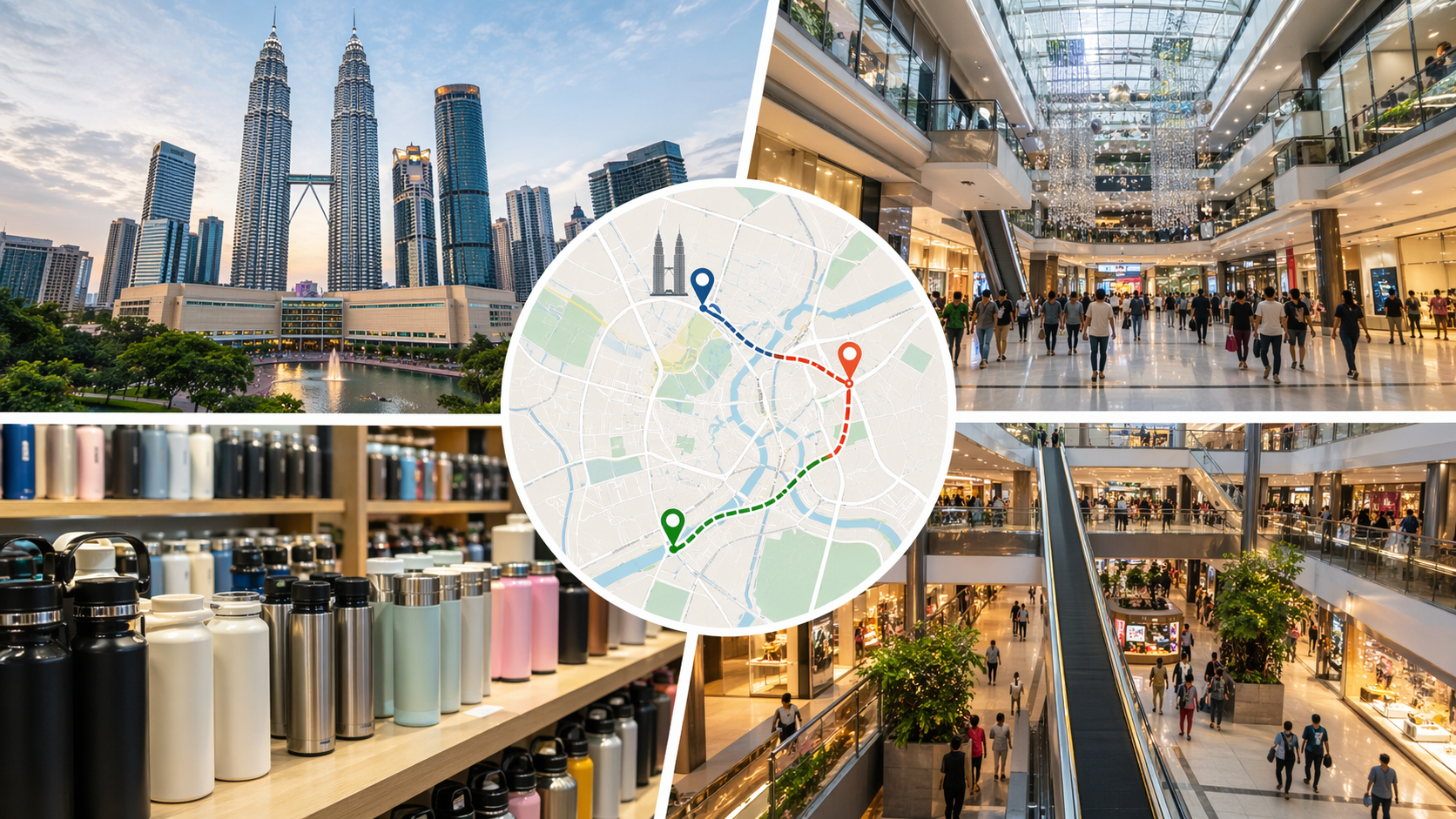
If you look at Southeast Asia from a consumer behavior perspective, Kuala Lumpur stands out as one of the most mature urban retail ecosystems.
This is not just about having many malls. It’s about how those malls are structured:
- High-density retail clusters
- Clear segmentation (luxury / mid-range / mass)
- Strong integration of lifestyle + dining + daily essentials
Shopping malls are not just places to buy things—they are part of daily life infrastructure.
That’s why drinkware—especially water bottles, tumblers, and insulated cups—fits naturally into this ecosystem.
This guide will help you understand:
- Where to shop (mall-by-mall strategy)
- How to navigate KL’s retail layout
- What actually matters when buying drinkware
- How to avoid low-quality purchases
Section 1: Understanding KL’s Shopping Map (Very Important)
Before choosing a mall, you need to understand the shopping geography.
KL is not random—it’s structured around three main shopping zones.
1. KLCC Area (Premium + Tourist + Balanced)
Anchor mall:
- Suria KLCC
Positioning:
- Luxury + mid-range hybrid
- Strong international brands
- High accessibility (LRT connected)
This is one of the most iconic malls in Malaysia, located under the Petronas Twin Towers, combining retail with cultural and leisure spaces.
👉 Best for:
- First-time buyers
- Balanced selection (not too cheap, not too niche)
2. Bukit Bintang Area (Lifestyle + Trend + Variety)
Anchor mall:
- Pavilion Kuala Lumpur
Positioning:
- Premium lifestyle
- Trend-driven retail
- Strong visual merchandising
With over 500+ stores and a central location, it’s one of KL’s most dynamic shopping destinations.
👉 Best for:
- Design-oriented products
- Aesthetic drinkware
- Lifestyle upgrades
3. Mid Valley Area (Practical + Volume + Value)
Anchor malls:
- Mid Valley Megamall
- The Gardens Mall
Positioning:
- High volume retail
- Strong mid-range + affordable segment
- Local favorite
With hundreds of stores and strong connectivity, this is one of the most practical shopping hubs in KL.
👉 Best for:
- Everyday drinkware
- Price-performance shopping
- Bulk or family purchases
Section 2: Best Malls to Buy Drinkware (Detailed Breakdown)
🏆 Suria KLCC
Best for: Balanced Quality + Convenience
This is the most “complete” shopping experience.
Why it works:
- Mix of luxury + accessible brands
- Strong department stores
- Tourist-friendly layout
You can find:
- Premium stainless steel bottles
- International drinkware brands
- Lifestyle-oriented products
Plus:
- Bookstores like Kinokuniya
- Home sections inside department stores
👉 Insight:
If you don’t want to overthink, this is the safest place to start.
🏆 Pavilion Kuala Lumpur
Best for: Design, Aesthetics, and Lifestyle Drinkware
This mall is not just about shopping—it’s about visual experience.
Why it stands out:
- Strong lifestyle branding
- High-end presentation
- Trend-driven product selection
You’ll find:
- Designer tumblers
- Aesthetic bottles
- Gift-oriented drinkware
The mall also features over 700 stores and strong international brand presence.
👉 Insight:
If you care about how your bottle looks and feels, this is your place.
🏆 Mid Valley Megamall
Best for: Value and Everyday Practicality
This is where locals actually shop.
Why it matters:
- Huge selection (600+ stores)
- Strong mid-range brands
- Easy price comparison
👉 You’ll find:
- Affordable tumblers
- Sports bottles
- Family-use drinkware
👉 Insight:
If your goal is function + price efficiency, this is the best option.
🏆 The Gardens Mall
Best for: Premium, Quiet, and Refined Shopping
Connected directly to Mid Valley, but completely different vibe.
Why it works:
- Less crowded
- More premium brands
- Better shopping experience
👉 Ideal for:
- High-end insulated bottles
- Gift purchases
- Long-term use products
👉 Insight:
Think of this as the “upgrade version” of Mid Valley.
Section 3: Smart Shopping Route (Map Logic Strategy)
If you want efficiency, follow this route:
Route 1 (One-Day Efficient Plan)
Morning:
👉 Start at Suria KLCC
- Benchmark quality
- Understand price ranges
Afternoon:
👉 Move to Pavilion Kuala Lumpur
- Explore design-driven options
- Compare premium products
Evening:
👉 End at Mid Valley Megamall
- Find best value
- Make final purchase
Route Logic:
- KLCC = Benchmark
- Pavilion = Upgrade
- Mid Valley = Optimize
👉 This is how smart shoppers reduce decision mistakes.
Section 4: What Actually Matters When Buying Drinkware
Most people shop wrong.
They focus on:
- Price
- Brand name
- Appearance
But real decision factors are different.
1. Usage Frequency (Most Important)
Ask:
- Will I use this daily?
If yes →
Invest in better quality.
2. Drinking Style
- Straw → commuting / driving
- Sip → hot drinks
- Dual lid → mixed usage
3. Capacity vs Lifestyle
- Office → 500–700ml
- Travel → 700–1000ml
- Gym → 1L+
4. Material Quality
- 304 stainless steel → standard
- 316 stainless steel → higher durability
5. Leak-Proof Design
This is often overlooked.
Bad sealing =
👉 ruined bags, bad experience, low trust
Section 5: Common Mistakes Buyers Make
Mistake 1: Buying Based on Looks Only
Aesthetic ≠ usability
Mistake 2: Ignoring Lid Design
The lid defines:
- comfort
- speed
- spill risk
Mistake 3: Choosing Too Many Bottles
Better strategy:
👉 One good bottle > multiple average ones
Mistake 4: Not Matching Lifestyle
A gym bottle is not an office bottle.
Section 6: Local Insight (Real Behavior in KL)
From local patterns:
- Mid Valley is often preferred for practicality
- KLCC is a “first stop” for many visitors
- Pavilion attracts lifestyle-focused shoppers
Even community discussions show strong preference for Mid Valley as a practical choice, despite crowds.
👉 Translation:
- Locals optimize for value
- Tourists optimize for experience
Section 7: Final Recommendation Strategy
If you want a simple decision framework:
If you are new to KL
👉 Start with Suria KLCC
If you care about design
👉 Go to Pavilion Kuala Lumpur
If you want best value
👉 Choose Mid Valley Megamall
If you want premium experience
👉 Visit The Gardens Mall
Conclusion
Buying drinkware in Kuala Lumpur is not about finding “a store.”
It’s about understanding:
- Where to look
- How to compare
- What actually matters
Because in a city where malls are part of everyday life, the real advantage is not access—it’s decision clarity.