
From the Amazon Rainforest to Patagonia: Why Hydration Is Never One-Size-Fits-All
South America is a continent of contrasts.
Within a single journey, a traveler might experience humid rainforest air in northern Brazil, cool mountain winds in Peru, dry desert landscapes in Chile, and temperate urban climates in Argentina. Few places on Earth offer such remarkable environmental diversity.
This variety shapes more than landscapes and local cultures—it also influences one of the most fundamental aspects of daily wellness: hydration.
Most people are familiar with general advice such as "drink eight glasses of water a day" or "stay hydrated in hot weather." While these recommendations provide a useful starting point, they often overlook an important reality: hydration needs change depending on where you are, what the weather is like, and how your body interacts with the environment.
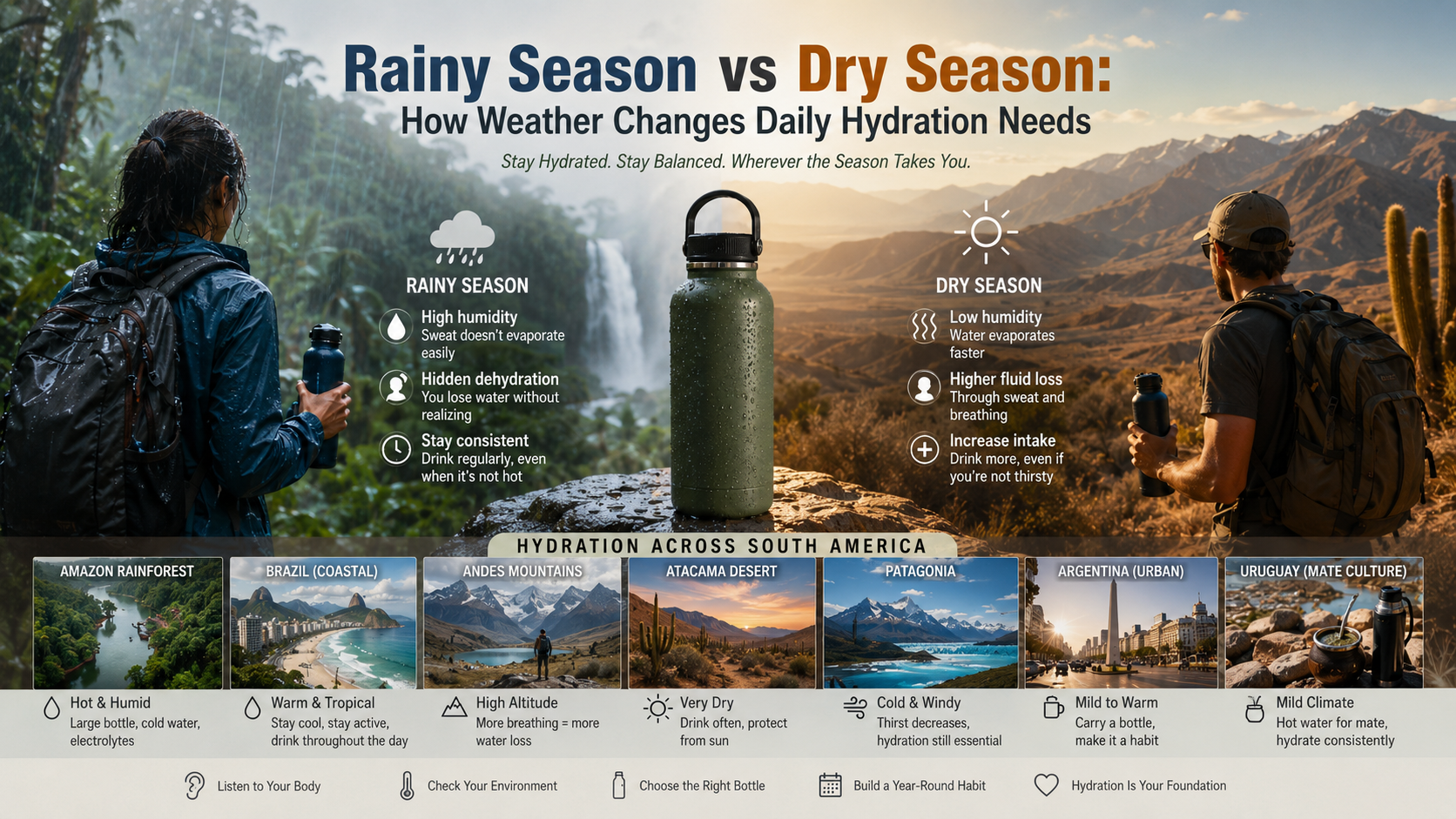
The difference between the rainy season and the dry season is a perfect example.
Many people assume they need more water only when temperatures rise. In reality, humidity, rainfall patterns, altitude, wind exposure, and seasonal climate changes can all affect how much water the body loses throughout the day.
Understanding these differences can help travelers, commuters, outdoor enthusiasts, and everyday consumers build healthier hydration habits—and choose drinkware that better supports those habits.
South America's Geography Creates a Natural Hydration Laboratory
One reason South America provides such a fascinating case study is its extraordinary geographic diversity.
The continent contains:
- The world's largest tropical rainforest
- One of the driest deserts on Earth
- Extensive mountain ranges
- Long coastlines
- Temperate grasslands
- Subtropical cities
- Cold southern regions
Each environment creates unique hydration challenges.
A person living in the humid Amazon Basin experiences water loss differently than someone hiking through the Andes or commuting through Santiago during a dry summer.
This makes South America an ideal lens through which to understand how weather affects hydration.
The Human Body Is Constantly Losing Water
Before examining seasonal differences, it helps to understand a basic fact:
Your body is always losing water.
Even when sitting still, water leaves the body through:
Breathing
Every breath releases moisture into the air.
Perspiration
Not all sweat is visible.
The body continuously produces small amounts of perspiration, even when you don't feel particularly hot.
Digestion
Normal metabolic processes require water.
Daily Activity
Walking, working, commuting, exercising, and even thinking contribute to overall energy expenditure and water use.
The challenge is that environmental conditions can significantly increase or disguise these losses.
Why Rainy Seasons Can Be Surprisingly Dehydrating
When people think about dehydration, they often imagine bright sunshine and scorching temperatures.
Rainy weather rarely comes to mind.
Yet many tropical regions experience significant hydration challenges during wet seasons.
High Humidity Changes How Sweat Works
One of the body's primary cooling mechanisms is sweat evaporation.
When sweat evaporates, it helps remove heat from the skin.
However, humid air is already saturated with moisture.
As a result, sweat evaporates less efficiently.
The body responds by producing even more sweat in an attempt to cool itself.
Many people end up losing substantial amounts of water without realizing it.
Because sweat remains on the skin rather than evaporating quickly, it may not feel like significant water loss is occurring.
In reality, the opposite may be true.
The Amazon Rainforest: A Perfect Example
Amazon Rainforest offers one of the clearest examples of this phenomenon.
The region is characterized by:
- High temperatures
- High humidity
- Frequent rainfall
- Dense vegetation
Visitors often assume that rainy conditions reduce dehydration risk.
Yet many people discover that they sweat continuously throughout the day.
Hydration becomes especially important because moisture loss remains high despite the presence of abundant rainfall.
Rain outside does not necessarily mean adequate hydration inside the body.
Why People Drink Less During Rainy Weather
Psychology also plays a role.
On cooler or cloudy days, thirst signals may feel less urgent.
Many individuals naturally reduce their water intake without consciously deciding to do so.
Over time, this can contribute to mild dehydration, reduced energy levels, and increased fatigue.
Dry Seasons Create Different Challenges
If rainy seasons disguise water loss, dry seasons often accelerate it.
Low humidity environments encourage rapid evaporation.
This affects both visible sweat and moisture released through breathing.
Water Loss Can Become Nearly Invisible
One reason dry climates are deceptive is that sweat disappears quickly.
People may assume they are not sweating very much.
In reality, perspiration evaporates almost immediately.
This can create a false sense of hydration.
The body continues losing water even when clothing remains dry.
Why Dry Air Feels Different
Many travelers notice symptoms such as:
- Dry lips
- Dry skin
- Dry eyes
- Increased thirst
These sensations reflect the body's response to lower environmental moisture levels.
The drier the air becomes, the harder the body works to maintain moisture balance.
The Andes: Where Altitude Changes Everything
The Andes Mountains introduce another important factor: elevation.
Many South American cities sit at surprisingly high altitudes.
Examples include:
- Cusco
- La Paz
- Quito
- Bogotá
Higher elevations influence hydration in several ways.
Breathing Increases Water Loss
At altitude, oxygen levels decrease.
The body compensates by increasing respiratory activity.
This means more moisture leaves the body through every breath.
Even without visible sweating, hydration needs often increase.
Strong Sunlight Increases Stress on the Body
Mountain environments frequently experience intense solar exposure.
Temperatures may feel comfortable, yet ultraviolet radiation remains strong.
This combination can increase overall physiological stress and contribute to fluid requirements.
Why Travelers Often Underestimate High-Altitude Hydration
Many visitors focus on altitude sickness while overlooking hydration.
However, maintaining fluid intake is one of the simplest ways to support overall comfort during high-altitude travel.
The Atacama Desert: One of Earth's Driest Environments
Among South America's most extraordinary landscapes is the Atacama Desert.
Some areas receive extremely little rainfall.
In these conditions, the atmosphere constantly pulls moisture from surfaces—including the human body.
Dehydration Doesn't Always Feel Dramatic
People often expect dehydration to be obvious.
Yet in desert environments, mild dehydration can develop gradually.
Signs may include:
- Reduced concentration
- Mild headaches
- Dry mouth
- Fatigue
Regular water consumption becomes essential, even when thirst seems manageable.
Patagonia: Cold Weather Doesn't Eliminate Hydration Needs
Many people associate hydration with heat.
Patagonia demonstrates why this assumption can be misleading.
Patagonia is known for:
- Cool temperatures
- Strong winds
- Vast open landscapes
Despite the cooler climate, hydration remains important.
Cold Air Can Still Be Dry
Winter and cold-weather environments often contain relatively dry air.
Breathing continues to remove moisture from the body.
Outdoor activity can further increase fluid loss.
Thirst Becomes Less Reliable
Research consistently shows that cold weather can suppress thirst perception.
People may need water without feeling particularly thirsty.
As a result, intentional hydration habits become increasingly valuable.
How Different South American Countries Approach Hydration
Climate influences not only water requirements but also drinking habits.
Across South America, local traditions often reflect environmental realities.
Brazil: Hydration for Warm and Tropical Conditions
Brazil's climate varies significantly, but many regions experience warm temperatures throughout much of the year.
Cold beverages remain popular, particularly in coastal cities.
For many consumers, larger insulated bottles help maintain refreshment during outdoor activities, commuting, and beach visits.
Argentina: A Blend of Climates and Traditions
Argentina spans multiple climate zones.
In addition, the country's strong mate culture has influenced drinkware habits for generations.
Hot-water retention remains important for people who enjoy sharing traditional mate throughout the day.
Uruguay: The Influence of Mate Culture
Uruguay is often recognized for its deep connection to Yerba Mate.
Many people carry insulated flasks as part of everyday life.
In this case, hydration and cultural tradition intersect.
The drinkware is not simply a container—it supports a daily ritual.
Chile: Climate Extremes in a Single Country
Few countries illustrate climate diversity as dramatically as Chile.
From desert regions in the north to colder southern landscapes, hydration strategies may change considerably depending on location.
Versatile insulated drinkware often becomes particularly useful in such varied conditions.
How Drinkware Supports Better Hydration Habits
Hydration is not solely about water quantity.
Convenience also matters.
Behavioral studies consistently show that people are more likely to drink water when it is readily accessible.
This is where drinkware design becomes surprisingly important.
Visibility Encourages Consistency
A bottle placed nearby serves as a reminder.
Small visual cues can encourage regular hydration throughout the day.
Temperature Influences Drinking Behavior
Many people simply prefer water at certain temperatures.
When beverages remain pleasant to drink, people often consume more of them.
This helps explain why insulated bottles have become increasingly popular.
Capacity Affects Daily Routines
Different environments call for different bottle sizes.
Examples include:
- Large bottles for outdoor activities
- Mid-sized bottles for commuting
- Compact bottles for travel
Choosing a size that fits daily habits often improves consistency.
Seasonal Hydration Is About Adaptation
One of the most useful lessons from South America's diverse geography is that hydration should remain flexible.
There is no universal number that works perfectly for everyone.
Instead, effective hydration involves adapting to:
- Temperature
- Humidity
- Altitude
- Activity level
- Seasonal changes
The same person may require different hydration strategies throughout the year.
Small Habits That Make a Big Difference
Regardless of climate, several simple practices can improve hydration:
Start the Day With Water
Beginning the morning hydrated helps establish momentum.
Carry Water Consistently
Accessibility often determines consumption.
Adjust Intake Based on Conditions
Hot, humid, dry, or high-altitude environments may require additional attention.
Pay Attention to Comfort Signals
Energy levels, concentration, and thirst can all provide useful feedback.
Use Drinkware That Fits Your Lifestyle
The best bottle is usually the one you enjoy carrying and using every day.
Conclusion: Weather Changes, Hydration Should Too
From the humidity of the Amazon to the winds of Patagonia, South America's landscapes remind us that hydration is never static.
Rainy seasons and dry seasons affect the body differently. High humidity can disguise water loss, while dry air can accelerate it. Mountain elevations introduce additional challenges, and cold climates can reduce awareness of thirst.
The most effective hydration habits are not built around rigid rules but around awareness and adaptation.
Understanding how weather influences water needs allows us to make better daily decisions—whether we're commuting through a city, exploring the outdoors, traveling across countries, or simply enjoying everyday life.
And sometimes, one of the simplest tools for supporting those habits is a well-designed bottle that keeps water within reach, at a temperature we enjoy, wherever the season takes us.
References
- World Health Organization (WHO) – Hydration and Health Resources
- World Meteorological Organization (WMO) Climate Resources
- National Weather Service – Heat and Hydration Safety
- Centers for Disease Control and Prevention (CDC) – Hydration Guidance
- Food and Agriculture Organization of the United Nations (FAO) Climate Data Resources
- National Institute of Yerba Mate (INYM) Cultural Resources
- United Nations Environment Programme (UNEP) Environmental Reports
- Specialty Coffee Association (SCA) Beverage and Consumption Resources
- Pan American Health Organization (PAHO) Public Health Resources