
Introduction: A Simple Object, A Complex Evolution
At first glance, drinkware appears to be one of the most ordinary objects in daily life. A container designed to hold water—nothing more, nothing less. Yet, over the past few decades, this seemingly simple product category has undergone a profound transformation.
Today, drinkware is no longer just about hydration. It has evolved into a reflection of lifestyle, identity, and even personal values. Consumers are no longer asking, “Does it hold water?” Instead, they are asking:
- Does it fit my routine?
- Does it match my style?
- Does it enhance my daily experience?
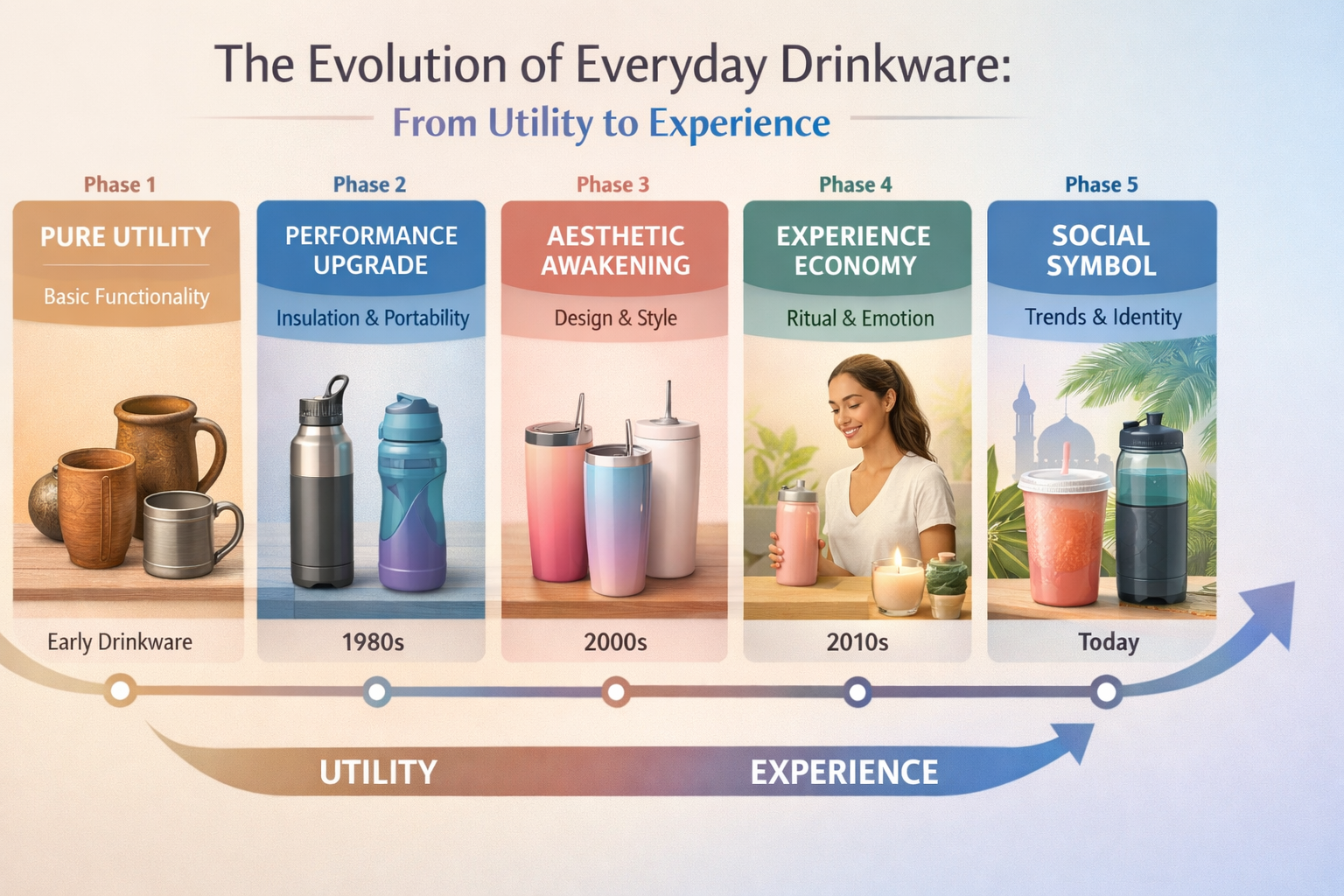
This shift marks a fundamental transition—from utility to experience. To understand how this happened, we need to trace the evolution of drinkware across different phases of consumer behavior, technological advancement, and cultural change.
Phase One: Pure Utility — Survival and Basic Functionality
Early Origins of Drinkware
The earliest forms of drinkware were born out of necessity. Ancient civilizations used whatever materials were available—clay, wood, animal horns, and later metals—to create vessels for storing and consuming liquids.
The design priorities were straightforward:
- Durability
- Availability of materials
- Ease of use
There was no concept of branding, aesthetics, or emotional attachment. Drinkware existed purely as a tool for survival.
Industrial Standardization
With the rise of industrialization, drinkware production became standardized. Materials like stainless steel, aluminum, and plastic enabled mass production at scale. This era introduced:
- Uniform shapes and sizes
- Cost-efficient manufacturing
- Basic sealing mechanisms
Functionality remained the dominant driver. The goal was efficiency, not differentiation.
Consumer Mindset
During this phase, consumers viewed drinkware as a low-involvement product:
- Minimal brand loyalty
- Price-sensitive decisions
- Replacement rather than upgrade mindset
Summary of Phase One:
Drinkware functioned purely as a commodity—interchangeable, utilitarian, and largely invisible in daily life.
Phase Two: Performance Upgrade — Technology Reshapes Expectations
The Insulation Revolution
The introduction of vacuum insulation technology marked a major turning point. Double-wall construction allowed drinkware to maintain temperature for extended periods, significantly enhancing usability.
This innovation shifted drinkware from passive storage to active performance:
- Hot drinks stayed hot for hours
- Cold beverages remained chilled in tropical climates
- Users gained control over their consumption experience
Ergonomics and Portability
As lifestyles became more mobile, drinkware design adapted:
- One-hand operation lids
- Leak-proof mechanisms
- Integrated straws for convenience
- Slim profiles for portability
Drinkware began aligning with specific use cases—commuting, gym sessions, outdoor activities.
Health and Safety Awareness
Consumers also became more conscious of material safety:
- BPA-free plastics
- Food-grade stainless steel
- Odor-resistant interiors
Health considerations became a key purchase driver, particularly among urban consumers.
Consumer Shift
The decision-making process evolved:
- From “good enough” → “best performance for my needs”
- From generic → purpose-driven selection
Summary of Phase Two:
Drinkware transitioned into a functional product, where performance and usability became central to differentiation.
Phase Three: Aesthetic Awakening — Design Enters the Scene
The Rise of Visual Culture
The emergence of social media platforms fundamentally changed how products are perceived. Objects once considered purely functional were now part of a visual narrative.
Drinkware entered this ecosystem as:
- Desk accessories
- Gym essentials
- Lifestyle props in daily content
Appearance became a competitive advantage.
Design Innovation
Brands began investing in:
- Color palettes (pastels, gradients, muted tones)
- Surface finishes (matte, powder-coated, glossy)
- Unique silhouettes (tumblers, flasks, straw cups)
Design was no longer secondary—it became a primary selling point.
Personal Identity Expression
Consumers started using drinkware as an extension of their identity:
- Minimalist designs for professionals
- Bright, playful colors for younger audiences
- Neutral tones for lifestyle-focused users
The product moved from being owned to being chosen.
Consumer Shift
The mindset evolved again:
- From “What works?” → “What represents me?”
Summary of Phase Three:
Drinkware became a lifestyle accessory, blending functionality with personal expression.
Phase Four: Experience Economy — Drinkware as Emotional Design
The Ritualization of Hydration
In modern lifestyles, hydration is no longer just a necessity—it is part of self-care.
Daily routines now include:
- Morning hydration rituals
- Scheduled water intake during work
- Post-workout replenishment
Drinkware plays a central role in these micro-moments, turning them into intentional habits.
Multi-Sensory Experience
Consumers now evaluate drinkware based on how it feels:
- The tactile experience of the surface
- The smoothness of drinking flow
- The sound and feedback of lid mechanisms
These seemingly small details contribute to overall satisfaction.
Emotional and Psychological Value
Owning a well-designed bottle can create:
- A sense of organization
- Motivation to stay hydrated
- A subtle boost in daily productivity
Products that enhance routines tend to generate stronger emotional attachment.
Brand Narrative and Meaning
Brands increasingly position drinkware within broader narratives:
- Sustainability and environmental responsibility
- Wellness and healthy living
- Simplicity and mindful consumption
Consumers are not just buying a product—they are aligning with a mindset.
Consumer Shift
The evolution reaches a deeper level:
- From “use” → “experience”
Summary of Phase Four:
Drinkware becomes an experience-driven product, where emotional value complements functionality.
Phase Five: Social and Cultural Symbol — Drinkware in Modern Identity
The Rise of Viral Drinkware
Certain drinkware styles have achieved viral status:
- Large-capacity tumblers
- Straw-based hydration bottles
- Minimalist insulated flasks
These products spread rapidly through digital communities, creating shared preferences.
Community and Belonging
Drinkware now reflects group identity:
- Fitness enthusiasts prefer high-capacity bottles
- Office workers favor sleek, minimal designs
- Students choose portable and expressive styles
Owning a certain type of drinkware signals belonging to a specific lifestyle group.
Regional Influence: Southeast Asia Context
In markets like Malaysia and Indonesia, local conditions shape usage patterns:
- Hot, humid climates increase demand for cold retention
- Cultural practices emphasize hydration during fasting periods
- Portable designs suit urban mobility
Consumers prioritize:
- Long-lasting cooling performance
- Large volume capacity
- Lightweight portability
Consumer Shift
The product becomes communicative:
- From “personal tool” → “social signal”
Summary of Phase Five:
Drinkware evolves into a cultural and social symbol, reflecting both individual identity and shared habits.
Key Industry Shift: What Drove This Evolution?
The transformation of drinkware is not accidental—it is driven by a combination of structural forces.
1. Technological Innovation
Advancements in insulation, materials, and manufacturing enabled higher performance and better user experiences.
2. Lifestyle Upgrades
As consumers became more health-conscious and routine-driven, hydration gained importance as a daily habit.
3. Social Media Amplification
Visual platforms accelerated trend cycles, turning everyday objects into lifestyle statements.
4. Design Democratization
Good design is no longer exclusive. Consumers now expect aesthetic quality even in basic products.
5. Sustainability Awareness
Reusable drinkware aligns with growing environmental concerns, making it both practical and responsible.
Future Outlook: Where Drinkware Is Heading Next
Smart Integration
Future drinkware may include:
- Hydration tracking
- Temperature display
- App connectivity
This bridges the gap between physical products and digital ecosystems.
Hyper-Personalization
Customization is becoming more accessible:
- Color selection
- Modular accessories
- Personalized engraving
Consumers increasingly expect products tailored to their preferences.
Sustainability as a Standard
Eco-conscious design will no longer be optional:
- Recycled materials
- Minimal packaging
- Long product lifecycles
Sustainability will move from differentiation to baseline expectation.
System-Based Lifestyle Products
Drinkware may integrate into broader systems:
- Fitness tracking ecosystems
- Workplace productivity tools
- Travel and outdoor gear setups
This reflects a shift toward holistic lifestyle design.
Conclusion: From Object to Experience
The evolution of drinkware tells a larger story about how consumer expectations have changed. What was once a simple container has become a multidimensional product that intersects with:
- Functionality
- Design
- Emotion
- Identity
Today, choosing a bottle is not just about hydration—it is about how seamlessly it fits into daily life and how well it reflects personal priorities.
In this sense, drinkware is no longer just something we use. It is something we experience, something we carry, and increasingly, something that represents us.
The evolution of drinkware reflects not just how we drink—but how we live.