

From Pop-Up Straws to Giant Tumblers: Why Some Drinkware Designs Take Over the Market
Drinkware is supposed to be simple.
It holds water. It keeps drinks warm or cold. It fits into a bag.
And yet, every few years, a specific bottle shape seems to dominate social media feeds, school corridors, office desks, and gym lockers.
Some designs become cultural symbols. Others quietly disappear.
This is not random. Drinkware trends follow the same emotional cycles as fashion, tech gadgets, and even sneakers.
Let’s revisit some of the most viral drinkware types of the past decade — and examine why they became so popular.
The Pop-Up Straw Bottle Era
The pop-up straw bottle was once everywhere.
One press of a button, and the lid flipped open. A straw appeared. One hand operation. No tilting required.
This design exploded in popularity among students, commuters, and gym users.
Why it worked:
Convenience was visible. The mechanism itself looked “smart.”
It felt modern and slightly futuristic.
The flip lid added a small moment of interaction — and humans love interactive objects.
The rise of fitness culture amplified this design. Hydration became part of daily routine narratives. People wanted a bottle that looked active.
But the same mechanism that made it exciting also created its weakness.
Over time, users noticed:
Cleaning was complicated.
The spring mechanism could wear out.
Straws required replacement.
The novelty faded. Function remained, but the “wow” moment disappeared.
The pop-up straw bottle didn’t fail. It simply normalized.
The Giant Tumbler Phenomenon
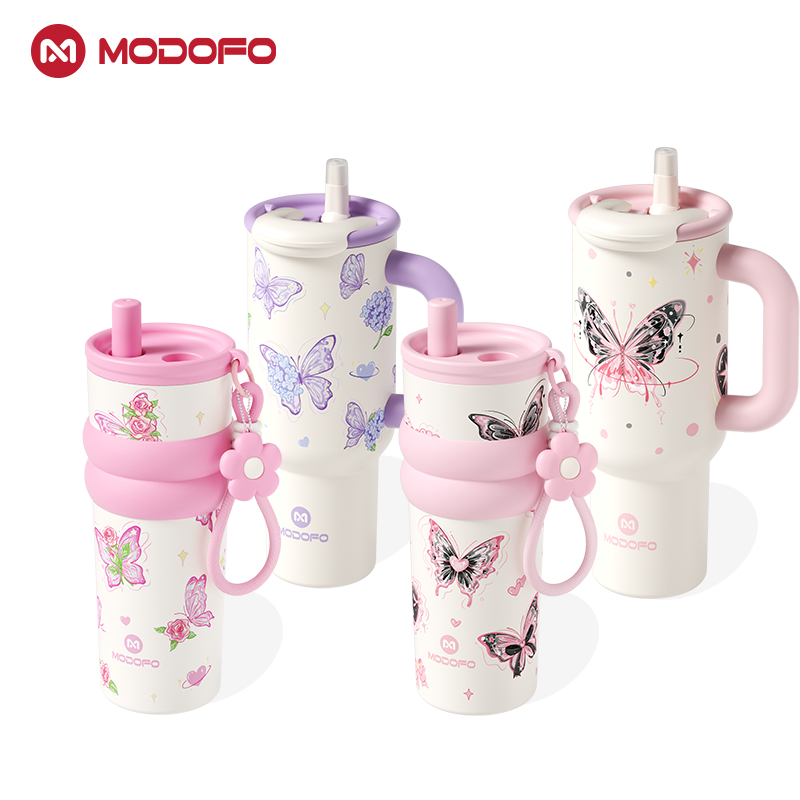
Then came the oversized tumbler era — often nicknamed “吨吨桶.”
Large 30–40 oz tumblers suddenly dominated desks and dashboards.
The cultural shift behind this trend was powerful.
Hydration became quantified. “Drink more water” turned into a visible daily goal.
Carrying a massive tumbler signaled discipline.
The exaggerated size made it instantly recognizable. On social media, proportion matters. A large bottle looks dramatic in photos.
One of the most talked-about examples was the Stanley Quencher, which saw explosive popularity online due to its size, handle design, and car-cup compatibility.
Why giant tumblers went viral:
They symbolized productivity.
They aligned with gym and wellness aesthetics.
They created a visual identity.
But practical reality followed.
They were heavy when full.
Not ideal for compact bags.
Overcapacity was unnecessary for many users.
After peak popularity, the market began splitting into mid-sized alternatives.
The giant tumbler became a symbol of a specific era of hyper-visible self-improvement culture.
The Transparent Minimalist Wave
Transparent bottles made from materials like Tritan entered the spotlight during the minimalist design movement.
Clear bottles communicate purity.
You see the water level. You see cleanliness. You see simplicity.
The appeal was psychological.
Transparency creates trust.
It also fit perfectly with clean desk aesthetics and neutral color palettes that dominated lifestyle content.
These bottles were lightweight and modern. They photographed well.
However, they had limitations.
No insulation.
Surface scratches were visible.
Long-term durability varied.
Their popularity reflected a broader design trend rather than a structural innovation.
When aesthetic preferences shifted, demand stabilized.
The Glass Bottle Comeback
Glass bottles have existed for centuries. But they periodically resurface as a premium, “clean living” statement.
The appeal is rooted in material perception.
Glass feels pure. Neutral. Taste-preserving.
In periods when consumers become skeptical of plastics, glass regains visibility.
However, glass thrives mainly in controlled environments — offices, homes, calm spaces.
Mobility challenges limit its dominance.
Glass never fully disappears. It moves in cycles of renewed trust and aesthetic preference.
The Stainless Steel Stability
While other designs rise and fall, stainless steel bottles — especially those made from 304 stainless steel and 316 stainless steel — maintain a steady presence.
They rarely “go viral” in the dramatic sense.
Instead, they become the default.
Their success comes from functional reliability:
Insulation performance
Structural durability
Long service life
Stainless steel designs may adopt new shapes, colors, or lids, but the core structure remains stable.
Trends fluctuate around them, not instead of them.
Why Drinkware Trends Go Viral
Across all these examples, patterns emerge.
A drinkware design becomes popular when it satisfies at least two of the following:
It signals a lifestyle.
It is visually distinctive.
It solves a visible inconvenience.
It fits into a broader cultural narrative.
Pop-up bottles symbolized movement and convenience.
Giant tumblers symbolized discipline and abundance.
Transparent bottles symbolized clarity and minimalism.
Drinkware trends are rarely about hydration alone.
They are about identity.
And identity changes faster than engineering.
The Cycle of Visibility
Every viral drinkware design follows a predictable arc:
Novelty
Rapid adoption
Social amplification
Market saturation
Normalization
Social media accelerates this cycle dramatically.
A bottle does not need to be technologically revolutionary to become popular.
It needs to be shareable.
That is the real multiplier.
What Remains After the Trend
After hype fades, consumers return to practicality.
Weight.
Durability.
Ease of cleaning.
Compatibility with daily routine.
The designs that survive are not always the loudest ones.
They are the ones that quietly integrate into everyday life.
Drinkware trends are fascinating not because they change how we drink water — but because they reveal how we see ourselves at a given moment.
A bottle can be a tool.
Or it can be a statement.
And sometimes, for a brief cultural moment, it becomes both.