
Most people don’t fail at choosing a teapot because they lack information.
They fail because the information they get doesn’t match real life.
On paper, almost every teapot looks good:
- Elegant design
- High-quality material
- Multiple features
But after a few weeks, many of them end up unused.
Not because they’re “bad”—
but because they’re not practical enough for daily use.
So instead of asking:
“Which teapot is the best?”
A better question is:
“What kind of teapot actually fits into everyday life?”
This article answers exactly that—through real usage, not theory.
1. A Simple Truth: The Best Teapot Is the One You Keep Using
Let’s start with a reality check.
Most people don’t drink tea in a perfectly calm, dedicated setting every day.
They drink tea:
- While working
- Between meetings
- During short breaks
- At home, casually
This changes everything.
Because in these situations, what matters is not tradition or aesthetics—it’s:
👉 Ease, speed, and consistency
That’s why many beautifully designed teapots fail:
- Too delicate
- Too hard to clean
- Too inconvenient to handle
And the ones that succeed?
They usually share one thing:
They remove friction from daily use
2. Material: Not About Preference, But About Lifestyle Fit
Material is often presented as a “taste” choice.
In reality, it’s a lifestyle decision.
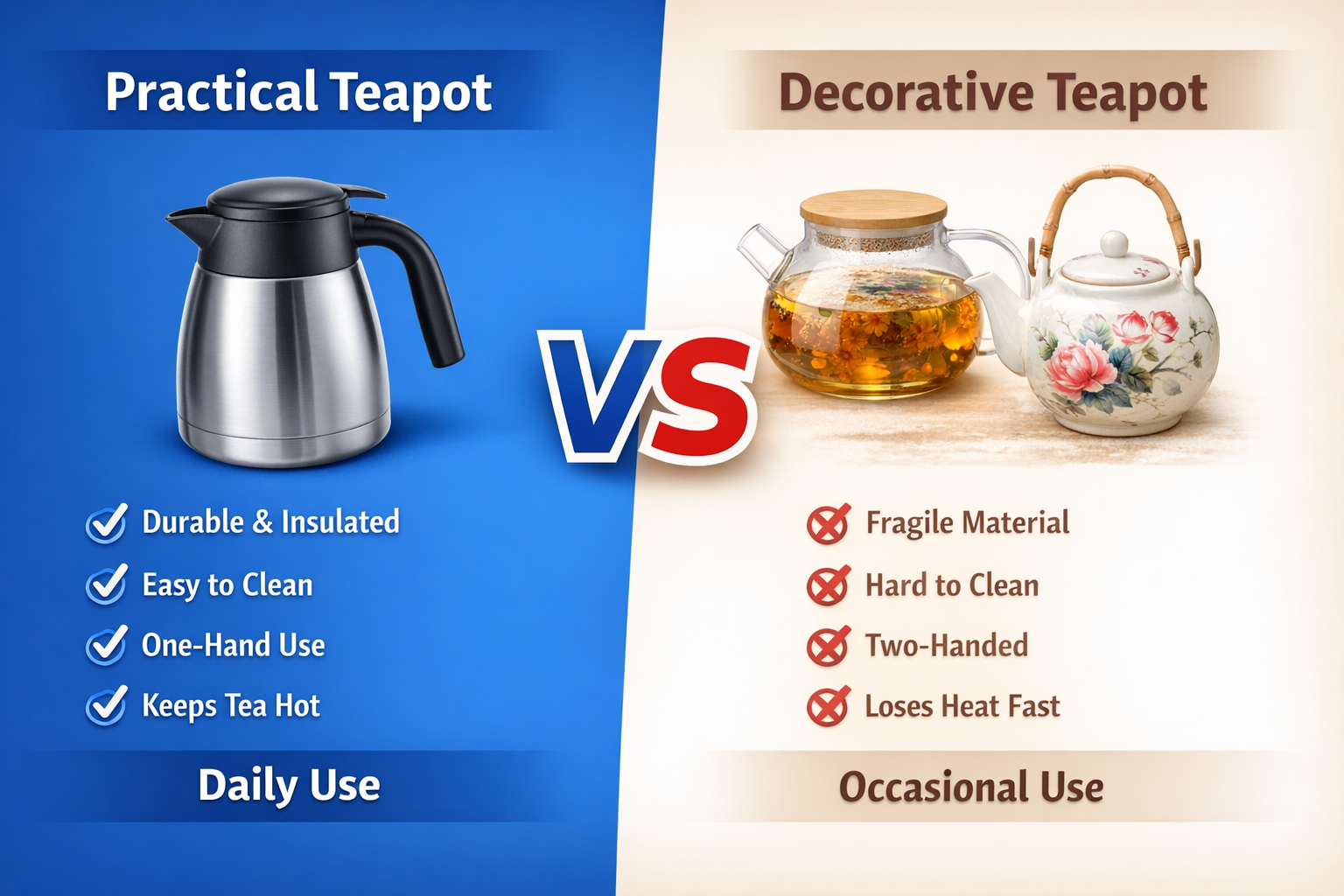
Glass: Visually Appealing, Operationally Fragile
Glass teapots are attractive for a reason:
- You can see the tea brewing
- They look clean and modern
But in daily use:
- They lose heat quickly
- They require careful handling
- They show stains easily
👉 Best for: slow-paced environments, occasional use
👉 Not ideal for: busy routines or frequent use
Ceramic: Comfortable but Context-Limited
Ceramic feels familiar and stable.
It works well when:
- You have a fixed place to use it
- You don’t move it often
But over time:
- It can become harder to clean
- It’s heavier and less flexible
- It’s not ideal for dynamic use (office, moving around)
👉 Best for: home setups, traditional tea moments
👉 Not ideal for: mobility or convenience
Stainless Steel: The Most Overlooked Practical Option
Stainless steel is rarely the “exciting” choice—but often the most used one.
Why?
Because it solves problems:
- Durable (no stress handling)
- Better heat retention
- Easy to maintain
More importantly:
👉 It adapts to different environments:
- Desk
- Kitchen
- Travel
👉 Best for: daily, repeated use
👉 Trade-off: less visual appeal
Key Insight
Most people start with what looks good.
But over time, they stick with what:
Feels effortless to use
3. Size: Why “Bigger” Often Becomes a Mistake
Another common assumption:
“A larger teapot is more useful.”
In reality, it often creates friction.
What Happens with Oversized Teapots
- You rarely fill them completely
- Tea sits longer and cools down
- They become heavier and harder to handle
Eventually:
👉 You stop using them regularly
What Actually Works Better
Think in terms of usage frequency, not capacity.
- Personal use → smaller, quicker cycles
- Shared use → moderate size
- Occasional gatherings → larger capacity
👉 The goal is simple:
Match the size to how often you actually drink tea
Practical Guideline
- Solo / desk use → medium-small
- 2–3 people → medium
- Group use → larger
👉 Anything beyond your daily need becomes inefficiency.
4. Cleaning: The Silent Reason People Quit Using a Teapot
This is the most underestimated factor.
Not design.
Not material.
👉 Cleaning.
What Makes a Teapot Annoying Over Time
- Narrow opening
- Fixed internal parts
- Hard-to-reach corners
At first, it’s manageable.
After repeated use:
- Tea stains build up
- Smell lingers
- Cleaning takes longer
And that’s when usage drops.
What Makes a Teapot Easy to Live With
- Wide opening
- Minimal internal structure
- Smooth inner surface
👉 The simpler the inside, the easier the maintenance.
Key Insight
People don’t stop using a teapot because they dislike tea.
They stop because:
Maintaining the teapot becomes a chore
5. Usability: Small Details That Decide Everything
Most product pages focus on features.
But real usability comes down to very small things.
Things That Actually Matter
- Does it pour smoothly?
- Does it drip?
- Can you hold it comfortably?
- Can you operate it with one hand?
Things That Don’t Matter as Much
- Extra mechanisms
- Over-designed features
- Complex structures
Key Insight
Every extra step in using a teapot adds friction.
And friction reduces usage.
6. The Shift: From “Tea Experience” to “Daily Utility”
There’s a subtle but important shift happening.
Traditionally, teapots were about:
- Ritual
- Craft
- Experience
Now, for many people, they are about:
- Convenience
- Efficiency
- Routine
What This Means for Your Choice
You’re not just choosing a teapot.
You’re choosing:
How much effort you’re willing to spend every day
7. So What Kind of Teapot Is Actually Practical?
After comparing everything, the answer becomes surprisingly simple.
A Practical Teapot Usually Has These Traits:
1. Durable Material
It doesn’t require careful handling.
2. Moderate Size
It matches your daily usage, not occasional needs.
3. Simple Structure
No unnecessary parts, easy to clean.
4. Reliable Pouring
No dripping, no awkward handling.
What This Often Looks Like in Reality
- Metal-based (especially insulated designs)
- Medium capacity
- Minimal internal complexity
Not the most eye-catching.
But:
👉 Highly usable
8. Why Insulated Designs Are Becoming More Relevant
One noticeable trend in recent years:
👉 More people are moving toward insulated designs.
Why?
Because they solve a key daily problem:
- Tea getting cold too quickly
What Insulation Changes
- You don’t need to rush drinking
- You don’t need to reheat
- You can use it more flexibly
This becomes especially useful:
- At work
- During long sessions
- In shared environments
Key Insight
Insulation doesn’t make a teapot “better” in theory.
It makes it:
More usable in real life
9. The Real Definition of “Worth It”
Most buying decisions are framed around price.
But for something used daily, a better metric is:
👉 How often you actually use it
A Simple Way to Think About Value
A teapot is “worth it” if:
- You use it frequently
- It doesn’t create extra effort
- It fits naturally into your routine
And Not Worth It If:
- You avoid using it
- You delay cleaning it
- You replace it quickly
10. Final Thought: Practicality Always Wins Over Time
At the beginning, people choose based on:
- Looks
- Trends
- First impressions
But over time, something else takes over:
👉 Ease of use
A teapot doesn’t need to be:
- The most beautiful
- The most traditional
- The most advanced
It just needs to be:
Easy enough that you’ll keep using it without thinking
Modofo Teapot - MODOFO 316 Stainless Steel Thermos Teapot