
Introduction: From Simple Containers to Everyday Systems
For decades, drinkware was treated as a purely functional product. A bottle held water. A mug held coffee. A tumbler made beverages portable. The value proposition was straightforward: durability, capacity, and basic usability.
Today, that simplicity no longer defines the category.
Drinkware has evolved into something more layered—part utility, part lifestyle accessory, part behavioral tool. It sits at the intersection of health, sustainability, design, and daily habit formation. What used to be an afterthought purchase is now a considered decision, often reflecting personal preferences, routines, and even identity.
This shift raises an important question:
What does the future of drinkware actually look like?
To answer that, it is necessary to examine not just product innovation, but the broader forces shaping the market—growth patterns, consumer expectations, and the emerging role of design in everyday use.
1. The Current State of the Drinkware Market
1.1 A Stable but Expanding Industry
The global drinkware market is not a volatile, trend-driven sector. Instead, it represents a stable, steadily growing category.
Recent industry estimates place the market size at approximately $38 billion in 2025, with projections suggesting it could exceed $50–55 billion within the next decade, growing at a compound annual growth rate (CAGR) of around 4–5%.
This type of growth is significant for one reason:
It is not driven by sudden innovation cycles, but by consistent demand embedded in daily life.
Drinkware is not seasonal. It is not optional. It is part of a recurring usage pattern—hydration, coffee consumption, commuting, and outdoor activity.
1.2 Reusable Drinkware as the Core Growth Driver
Within the broader market, reusable bottles represent the most dynamic segment.
As environmental awareness increases and regulations on single-use plastics tighten, consumers are shifting toward reusable alternatives. This transition is not a temporary trend—it is becoming a structural change.
Estimates suggest that the reusable water bottle segment alone could grow from approximately $11 billion in 2025 to over $17 billion by 2034, maintaining a growth rate above the overall category.
The implication is clear:
Future growth will not come from “more consumption,” but from replacement behavior—switching from disposable to reusable systems.
1.3 Regional Dynamics: The Rise of Asia-Pacific
One of the most important shifts in the market is geographical.
The Asia-Pacific region has emerged as a major growth engine, accounting for a significant share of global demand. Urbanization, rising disposable income, and increased awareness of sustainability are driving adoption.
In markets like Malaysia and Indonesia, drinkware is transitioning from a basic commodity to a lifestyle-oriented product, particularly among younger, urban consumers.
This creates a different competitive environment:
- Not yet saturated
- Highly responsive to design and branding
- Open to new product formats
1.4 What Is Driving Demand Today
Four primary forces are shaping current demand:
1. Sustainability Awareness
Consumers are actively reducing reliance on disposable plastics and seeking long-term alternatives.
2. Health and Hydration Habits
Increased focus on wellness has elevated hydration from a passive behavior to a tracked, intentional habit.
3. Mobility and Urban Lifestyles
Commuting, travel, and outdoor activities require portable, reliable drinkware.
4. Aesthetic and Social Value
Drinkware is increasingly visible in daily life—on desks, in gyms, in social media—turning it into a form of personal expression.
2. The Shift from Utility to Experience
Historically, drinkware was evaluated based on basic functional criteria:
- Does it hold liquid?
- Does it keep beverages hot or cold?
- Is it durable?
Today, these questions are no longer sufficient.
2.1 The Experience Layer
Consumers are now evaluating drinkware based on:
- How it feels to use daily
- Whether it affects the taste of beverages
- How easy it is to clean and maintain
- Whether it fits into their lifestyle routines
This represents a transition from functional utility → experiential value.
2.2 Fragmentation of Use Cases
Instead of one bottle serving all purposes, users are increasingly adopting multiple drinkware types for different scenarios:
- A bottle for gym use
- A tumbler for commuting
- A mug for coffee at home
This fragmentation reflects a deeper truth:
There is no longer a “general-purpose” solution—only context-specific optimization.
2.3 Emotional and Identity Factors
Drinkware is also becoming a subtle form of identity expression:
- Minimalist glass bottles signal simplicity
- Large insulated bottles reflect fitness-oriented lifestyles
- Aesthetic tumblers align with social and visual culture
This adds a new layer of value beyond performance.
3. Key Trends Shaping the Future of Drinkware
3.1 Sustainability as the Baseline, Not the Differentiator
Sustainability will no longer function as a premium feature—it will become the minimum expectation.
Future developments will likely include:
- Increased use of recyclable and bio-based materials
- Standardization of reusable systems in public spaces
- Circular models such as rental and return programs
In some environments, such as large events or stadiums, reusable cup systems are already being implemented at scale.
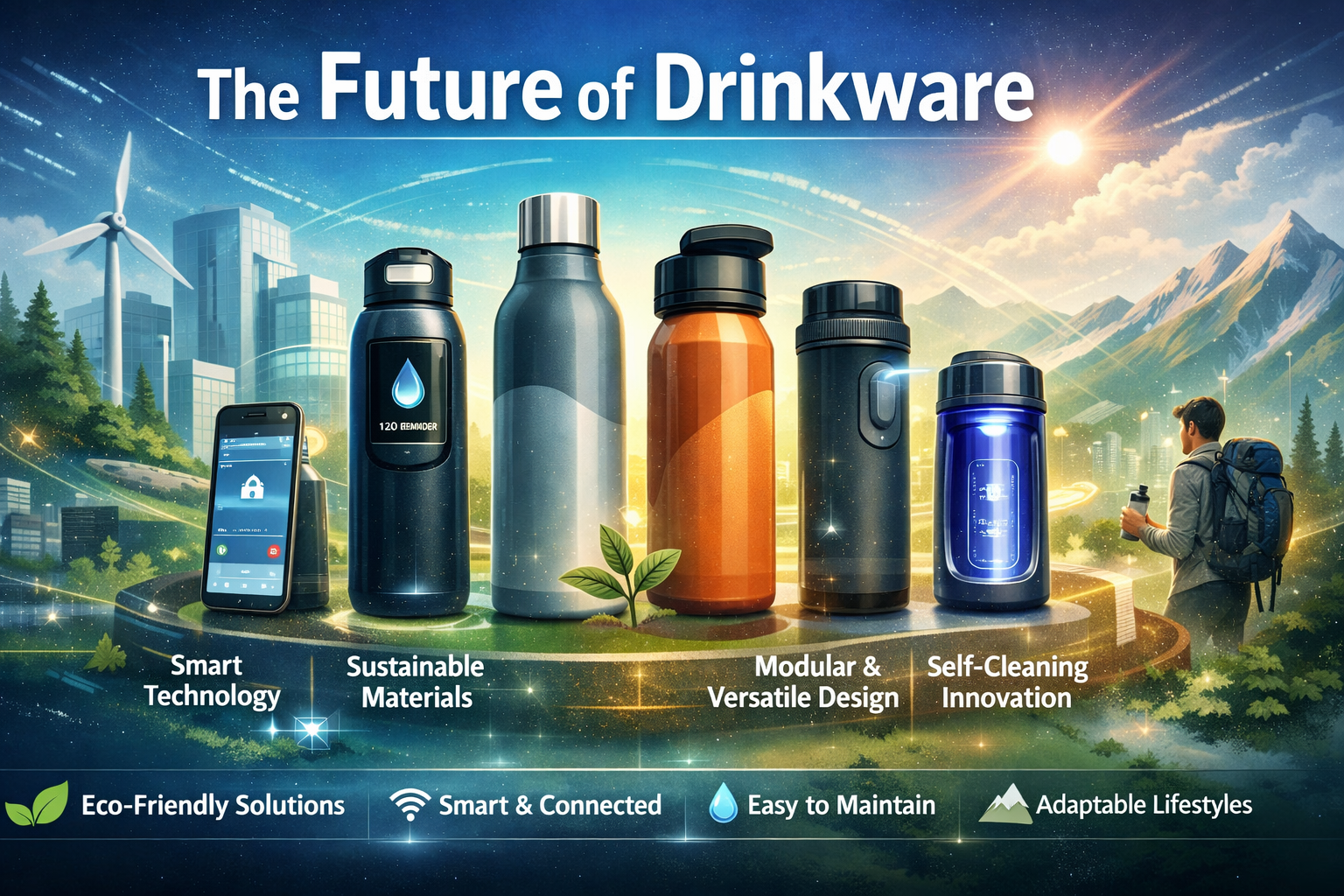
3.2 Smart Drinkware and Technology Integration
Technology is beginning to enter the category in subtle but meaningful ways:
- Hydration reminder systems
- Temperature tracking
- UV-based self-cleaning mechanisms
While still niche, these features point toward a broader trend:
Drinkware is evolving from a passive container into an active participant in daily routines.
3.3 Material Innovation for Better Experience
Material innovation is shifting focus from safety to experience optimization.
Examples include:
- Ceramic-coated interiors to reduce odor and flavor retention
- Advanced stainless steel finishes for smoother surfaces
- Improved plastics with lower odor absorption
The goal is no longer just to meet safety standards, but to improve long-term usability and consistency.
3.4 Design for Maintenance (A Critical Shift)
One of the most underappreciated trends is the growing focus on maintenance.
Future drinkware design is increasingly addressing:
- Ease of cleaning
- Faster drying
- Reduced internal complexity
This reflects a key insight:
The long-term value of drinkware is determined less by performance, and more by how easy it is to maintain that performance.
3.5 Multi-Scenario and Modular Design
As usage becomes more fragmented, products are adapting through flexibility:
- Interchangeable lids for different functions
- Modular accessories
- Hybrid designs that balance insulation and accessibility
Rather than forcing users to adapt to products, products are evolving to adapt to multiple user scenarios.
3.6 The Rise of Lifestyle-Centric Branding
Drinkware brands are no longer competing solely on specifications.
They are building ecosystems around:
- Outdoor lifestyles
- Fitness routines
- Work and productivity environments
In some cases, drinkware has become a core revenue driver for brands that originally operated in adjacent categories.
4. Changing Consumer Behavior
4.1 Increased Focus on Long-Term Experience
Consumers are becoming more sensitive to:
- Odor retention
- Cleaning difficulty
- Material interaction with beverages
This shifts purchasing decisions toward long-term usability rather than initial appeal.
4.2 Scenario-Based Decision Making
Instead of asking “Which bottle is best?”, users are asking:
- Which bottle is best for coffee?
- Which bottle is best for gym use?
- Which bottle is easiest to clean?
This represents a move toward context-driven selection.
4.3 Willingness to Pay for Better Usability
As expectations increase, consumers are more willing to invest in products that reduce friction:
- Easier maintenance
- Better taste experience
- More intuitive design
4.4 Integration into Daily Routines
Drinkware is becoming embedded in daily systems:
- Morning coffee routines
- Hydration tracking throughout the day
- Post-workout recovery
This makes it a habit-linked product category, not just a utility.
5. What the Future of Drinkware Will Likely Look Like
Based on current trends, future drinkware will evolve along four key dimensions:
5.1 Lower Maintenance Burden
Future products will aim to:
- Reduce odor retention
- Simplify cleaning processes
- Minimize hidden residue areas
5.2 Greater Scenario Specialization
Rather than universal solutions, users will rely on:
- Multiple specialized products
- Scenario-specific optimization
5.3 Increased Personalization
Customization will expand through:
- Colors and finishes
- Modular components
- Lifestyle alignment
5.4 Integration of Technology and Material Innovation
The next generation of drinkware will combine:
- Smart features
- Advanced materials
- Thoughtful design
Core Insight
The future of drinkware is not about better bottles—it is about better systems of use.
6. The Role of Design in the Next Generation of Drinkware (Light Brand Logic)
As expectations evolve, design is becoming the central differentiator.
Future-oriented drinkware will prioritize:
- Smooth interior surfaces for easier cleaning
- Coatings that reduce interaction with liquids
- Wide openings for accessibility
- Simplified structures to eliminate maintenance complexity
These are not superficial improvements—they directly impact how products perform over time.
The most effective designs will not necessarily add features, but will remove friction from everyday use.
7. Key Takeaways
- The drinkware market is stable but steadily expanding
- Reusable products are driving long-term growth
- Consumer expectations are shifting toward experience and usability
- Maintenance and design are becoming key differentiators
- The future lies in systems, not individual products
Conclusion: Beyond the Bottle
Drinkware is no longer defined by what it is made of or how it looks on a shelf.
It is defined by how it performs over time, how it integrates into daily life, and how little effort it requires to maintain.
As the category evolves, success will depend not on creating more products, but on creating better user experiences.
The future of drinkware is not about owning a better bottle—it is about building a better way to use it.
References & Supporting Sources
The insights and data presented in this article are informed by the following industry reports and research sources:
- Fortune Business Insights – Global Drinkware Market Reports
- Grand View Research – Drinkware Industry Analysis
- Technavio – Insulated Bottle Market Trends
- Astute Analytica – Reusable Bottle Market Forecast
- World Health Organization (WHO) – Sustainability and plastic reduction initiatives
- Journal of Materials Science – Material performance in food-contact applications
- Industry publications on reusable systems in public venues and events