
Introduction: The Bottle You Use vs. The Bottle You Own
Most people already own a water bottle. In fact, many own more than one—different sizes, styles, and designs collected over time. Yet, despite having access to these options, not all of them are used regularly.
Some bottles stay on shelves. Others are used for a few days, then forgotten. Only a few become part of daily life.
This raises an important question:
Why do certain water bottles become everyday essentials, while others are rarely used?
The answer has little to do with how advanced the bottle is, how many features it offers, or even how much it costs.
The real difference lies in something much simpler—and often overlooked:
Usability in real life.
The best water bottle isn’t the one with the most features. It’s the one you actually use every day.
Understanding what drives consistent use is the key to choosing better, designing better, and ultimately building better daily habits.
The Real Metric: Daily Usability Over Features
In many product categories, more features are often associated with higher value. But when it comes to everyday objects like water bottles, the relationship is not so straightforward.
Why Features Don’t Guarantee Usage
It’s easy to assume that a bottle with more functions—temperature control, measurement markers, smart tracking—will automatically be better. However, in practice, these features often go unused.
Why?
Because every added feature introduces complexity:
- More parts to manage
- More steps to use
- More potential points of failure
Instead of enhancing the experience, they can create friction.
The Cost of Friction
Daily use depends on ease. Even small inconveniences can accumulate:
- A lid that takes two hands to open
- A bottle that doesn’t fit into a bag easily
- A design that requires frequent cleaning
These minor issues might seem insignificant individually, but together they reduce the likelihood of consistent use.
Over time, friction leads to avoidance.
Redefining Value
In this context, value should not be measured by what a product can do, but by how often it is actually used.
A simple, well-designed bottle used every day delivers far more value than a complex one used occasionally.
Factor One: Effortless Accessibility
The first and most critical factor in daily usability is accessibility.
If a bottle is not easy to reach, open, and use, it will not become part of your routine.
One-Hand Operation
In real-life situations—working at a desk, driving, walking, or exercising—people rarely have both hands free. A bottle that supports one-hand operation significantly increases usage frequency.
Quick-access lids, flip-top mechanisms, or straw systems reduce the effort required to take a sip.
Always Within Reach
Accessibility is not only about design—it’s also about placement.
A bottle that stays:
- On your desk
- In your bag
- In your car
…is far more likely to be used than one stored out of sight.
Visibility creates opportunity.
No Setup Required
The best designs require no preparation. You don’t need to assemble parts, adjust settings, or think about how to use them.
You simply pick it up and drink.
If it’s not easy to grab, it won’t be used.
Factor Two: Comfortable Drinking Experience
Once accessibility is ensured, the next driver of consistent use is experience.
People naturally repeat actions that feel good.
Smooth Drinking Flow
The act of drinking should feel effortless. Bottles that require excessive suction or awkward tilting create subtle resistance.
A smooth flow encourages repeated use throughout the day.
Lid Design Matters
Different lid types serve different preferences:
- Straw lids for convenience
- Spout lids for controlled flow
- Wide-mouth openings for versatility
There is no single “best” option—only what fits the user’s behavior.
Ergonomics and Grip
Comfort extends to how the bottle feels in your hand:
- Balanced weight
- Non-slip surface
- Easy grip
When a bottle feels natural to hold, it becomes easier to integrate into daily movement.
A good experience doesn’t just satisfy—it encourages repetition.
Factor Three: The Right Capacity for Real Life
Capacity is one of the most misunderstood aspects of water bottle design.
Too Small: Constant Interruptions
A small bottle requires frequent refilling, which interrupts workflow and reduces consistency.
Over time, people simply stop refilling.
Too Large: Carrying Becomes a Burden
On the other hand, an overly large bottle can be inconvenient:
- Heavy to carry
- Difficult to fit into bags
- Less portable
This creates a different kind of friction.
Finding the Balance
The ideal capacity depends on context:
- Desk-based work: larger capacity reduces interruptions
- Outdoor activities: higher volume supports longer sessions
- Travel: moderate size balances portability and utility
In warmer climates, where hydration needs are higher, slightly larger capacities often provide a practical advantage.
The right capacity is not the biggest—it’s the one that fits your day.
Factor Four: Seamless Integration Into Daily Life
A water bottle should adapt to your routine, not disrupt it.
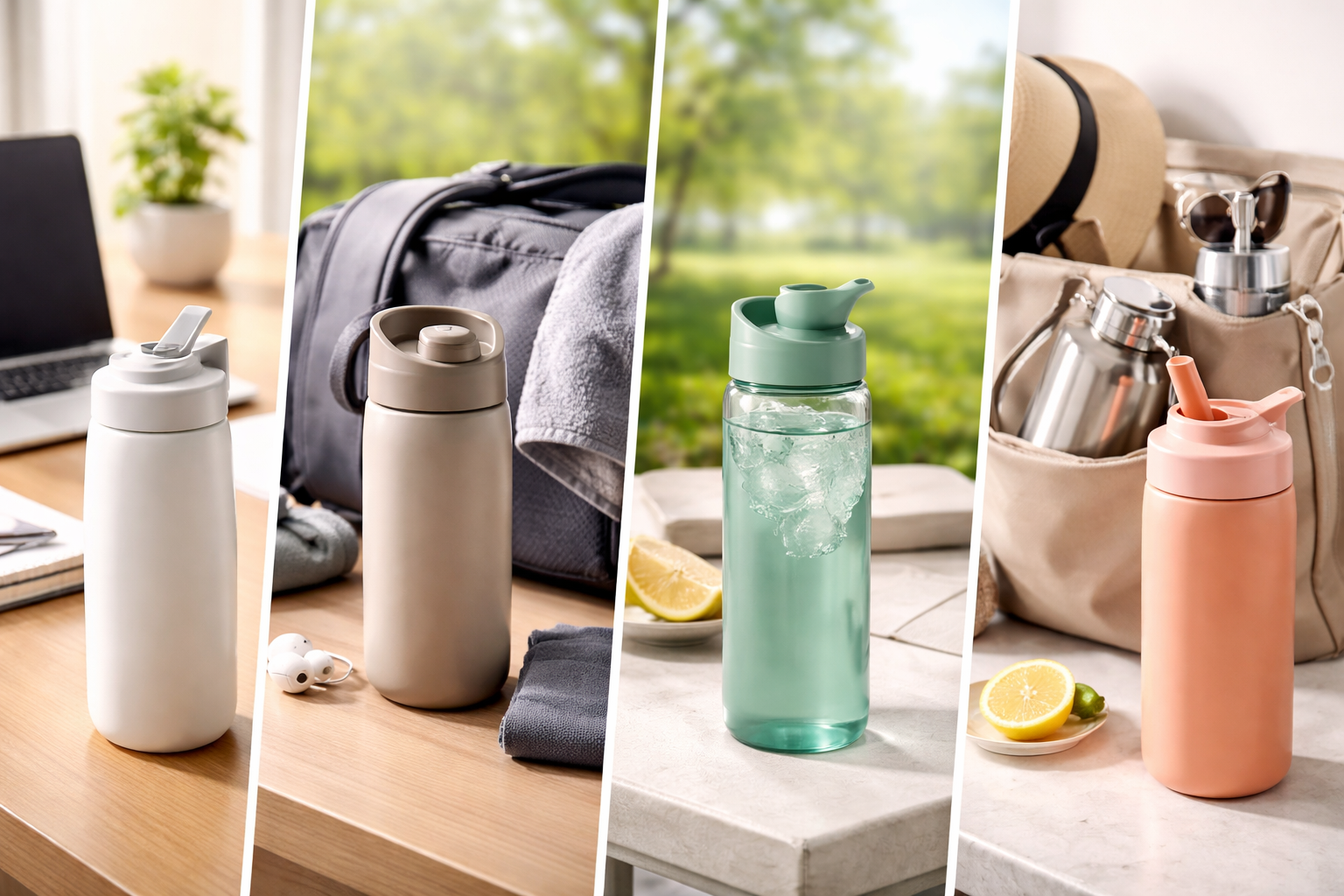
Designed for Specific Environments
Different environments require different features:
- Office: quiet, stable, spill-resistant
- Gym: durable, easy-access, high capacity
- Travel: compact, leak-proof, lightweight
A bottle that works well in one setting may not perform equally well in another.
Reducing Behavioral Interruptions
Every time you need to adjust your behavior to accommodate a product, friction increases.
The goal is to minimize these adjustments.
Consistency Through Compatibility
The more naturally a bottle fits into your environment, the more likely it is to be used consistently.
A good bottle doesn’t demand attention—it quietly supports your routine.
Factor Five: Low Maintenance, High Convenience
Long-term usability depends heavily on maintenance.
Ease of Cleaning
If a bottle is difficult to clean, it will eventually be used less.
Design elements that improve maintenance:
- Wide openings for easy access
- Minimal internal components
- Smooth surfaces that resist residue
Durability
Daily use requires resilience:
- Resistance to dents and scratches
- Stable materials that maintain performance over time
A durable bottle builds trust—users don’t need to worry about replacing it frequently.
Leak-Proof Reliability
Nothing discourages usage faster than leaks.
A reliable seal is not a premium feature—it is a baseline requirement.
If it’s hard to maintain, it won’t remain part of your routine.
Factor Six: Aesthetic and Emotional Appeal
While functionality is essential, aesthetics play a significant role in daily use.
Visual Motivation
People are naturally drawn to objects that look good. A visually appealing bottle is more likely to be:
- Carried outside
- Placed visibly on a desk
- Used consistently
Personal Identity
Drinkware has increasingly become part of personal expression:
- Minimalist designs for clean workspaces
- Sporty styles for active users
- Soft tones for lifestyle-oriented preferences
The design communicates subtle signals about identity and taste.
Emotional Connection
When users feel a connection to an object, they are more likely to keep using it.
People don’t just use what works—they use what they like.
Factor Seven: Climate and Context Awareness
Environmental factors directly influence how a bottle performs in real life.
Hot Climate Considerations
In warmer regions, hydration needs increase significantly. Bottles that maintain cold temperatures for longer periods become more valuable.
Cold water is not just a preference—it can improve the willingness to drink more frequently.
Higher Hydration Frequency
Frequent drinking requires:
- Easy access
- Consistent temperature
- Comfortable usability
Any friction is amplified when repeated multiple times a day.
Outdoor and Mobile Lifestyles
For users who spend more time outside, durability and insulation become even more critical.
The environment you live in should influence the bottle you choose.
Common Mistakes When Choosing a Water Bottle
Even with good intentions, people often make decisions that reduce long-term usability.
Choosing Based Only on Appearance
A good-looking bottle that is inconvenient to use will not last.
Overvaluing Features
More features often mean more complexity.
Ignoring Daily Context
A bottle that doesn’t fit your routine will be abandoned.
Selecting the Wrong Size
Capacity mismatches create friction over time.
A Simple Framework: How to Choose the Right Bottle
To simplify decision-making, consider a practical four-question filter:
1. Is it easy to use instantly?
No setup, no hesitation.
2. Does it fit my daily routine?
Compatible with your environment and habits.
3. Will I enjoy using it?
Comfort, design, and experience matter.
4. Can I maintain it easily?
Cleaning and durability should not be a burden.
If a bottle meets all four criteria, it is far more likely to become part of your daily life.
Conclusion: The Best Bottle Is the One That Stays With You
In the end, a water bottle proves its value not through specifications, but through presence.
The one you carry every day, the one you reach for without thinking—that is the one that works.
The shift is clear:
- From features → to usability
- From complexity → to simplicity
- From ownership → to consistent use
Because the real purpose of a water bottle is not to impress—it is to be used.
A water bottle proves its value not when you buy it—but when you keep using it.