
Introduction: It’s Not Just What You Drink—It’s How It Feels
Cold water or warm water—which is better for hydration?
It’s a question that comes up often, especially in hot climates, fitness routines, and everyday lifestyle discussions. Some people swear by ice-cold water for its refreshing effect. Others prefer warm water, claiming it feels gentler and easier to drink.
At first glance, it sounds like a simple comparison.
But the real answer is more nuanced.
Because hydration is not just about what you drink—it’s about how much you drink, how often you drink, and how naturally it fits into your daily routine.
And this is where temperature matters—not as a scientific winner, but as a behavioral driver.
In this guide, we’ll break down how cold and warm water actually affect hydration, when each one works best, and how your drinkware choices can support better daily hydration.
1. The Basics: Does Water Temperature Affect Hydration?
1.1 Hydration Is About Fluid Intake—Not Temperature
At its core, hydration is simple:
If you drink enough water, your body stays hydrated.
Your body absorbs water regardless of its temperature. Once consumed, water is adjusted internally to match body temperature before it is utilized.
This means:
- Cold water hydrates you
- Warm water hydrates you
- Room-temperature water hydrates you
From a purely physiological standpoint, temperature does not significantly change hydration effectiveness.
1.2 Where Temperature Actually Makes a Difference
If temperature doesn’t change hydration directly, why does it matter?
Because it affects:
- Drinking comfort
- Drinking speed
- Drinking frequency
In other words:
Temperature influences behavior—and behavior determines hydration.
For example:
- If cold water feels refreshing, you may drink more
- If warm water feels comfortable, you may sip more frequently
Both lead to better hydration—but through different patterns.
2. Cold Water: When and Why It Works Better
Cold water is often associated with refreshment and immediate relief—especially in hot conditions.
2.1 Immediate Cooling and Refreshment
In warm climates or after physical activity, cold water provides a noticeable cooling effect.
This is particularly relevant in:
- Tropical environments
- Outdoor activities
- High-temperature workplaces
Cold water helps lower perceived body temperature and provides instant comfort.
2.2 Encourages Higher Intake in Heat
When the environment is hot, people are naturally more inclined to drink cold water.
This leads to:
- Increased fluid intake
- Faster rehydration after sweating
In these conditions, cold water becomes a practical tool for maintaining hydration.
2.3 Better for Rapid Hydration Moments
Cold water is often consumed quickly.
Situations include:
- After exercise
- After prolonged sun exposure
- During intense physical activity
In these cases, the goal is speed—restoring lost fluids quickly.
Cold water supports this behavior by making large-volume drinking more appealing.
2.4 Limitations of Cold Water
Despite its advantages, cold water is not ideal in every situation.
Potential drawbacks include:
- Drinking too quickly, leading to less consistent hydration
- Temporary discomfort if consumed in large amounts
- Less suitable for slow, steady sipping
Cold water is effective for short-term hydration bursts, but not always for long-term consistency.
3. Warm Water: When It Makes More Sense
Warm or room-temperature water offers a very different experience.
Instead of intensity, it focuses on comfort and consistency.
3.1 Easier and More Comfortable to Drink
Warm water is generally:
- Gentler on the body
- Easier to sip continuously
- Less likely to cause discomfort
This makes it ideal for environments where hydration is ongoing rather than urgent.
3.2 Supports Consistent Drinking Habits
Unlike cold water, which encourages fast consumption, warm water supports slow, repeated intake.
This aligns with a “sip-based” hydration pattern:
- Small amounts
- Frequent intervals
- Stable hydration levels
Over time, this leads to more consistent daily hydration.
3.3 Better in Air-Conditioned Environments
In many modern settings—offices, homes, cafes—air conditioning reduces the need for cooling.
In these environments:
- Cold water may feel less appealing
- Warm water feels more natural
As a result, people are more likely to drink regularly when water is at a comfortable temperature.
3.4 Cultural and Lifestyle Preferences
Temperature preference is often influenced by culture.
For example:
- Many East Asian cultures favor warm or hot water
- Western habits often lean toward cold beverages
These preferences are shaped by:
- Climate
- Daily routines
- Long-term habits
Ultimately, there is no universal standard—only what works best in context.
4. Cold vs Warm: Real-Life Scenario Comparison
Instead of asking which is better overall, it’s more useful to ask:
Which is better in this specific situation?
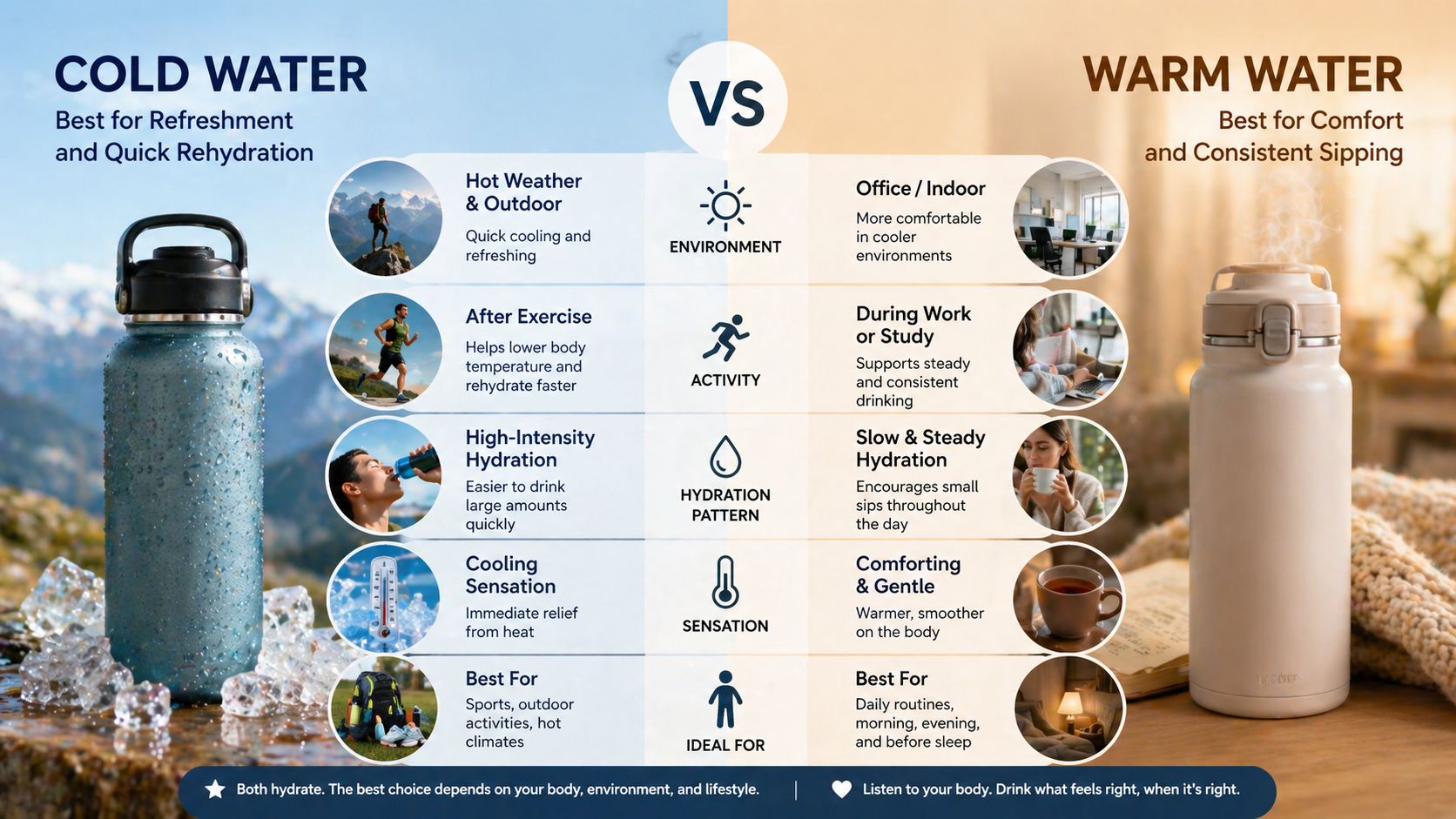
4.1 Hot Climate or Outdoor Conditions
Recommended: Cold water
- Encourages higher intake
- Provides immediate cooling
- Supports rapid hydration
4.2 Office or Indoor Work
Recommended: Warm or room-temperature water
- Easier to sip consistently
- More comfortable in cooler environments
4.3 Exercise and Physical Activity
Recommended: Combination approach
- Cold water for immediate recovery
- Followed by steady intake at a moderate temperature
4.4 Morning Routine
Recommended: Warm water
- More comfortable after waking
- Easier to drink on an empty stomach
4.5 Evening and Before Sleep
Recommended: Warm water
- Gentle and non-disruptive
- Encourages calm, slow intake
5. The Real Insight: Temperature Shapes Drinking Behavior
The key difference between cold and warm water is not hydration efficiency—it is behavioral pattern.
5.1 Cold Water → Fast, Occasional Drinking
- Larger volume per intake
- Less frequent
- Driven by thirst
5.2 Warm Water → Slow, Consistent Drinking
- Smaller amounts
- More frequent
- Integrated into routine
5.3 Why This Matters
Hydration is most effective when it is consistent.
This means:
The best water temperature is the one that helps you drink regularly—not just occasionally.
6. What This Means for Choosing Drinkware
Your bottle plays a critical role in how you drink water.
6.1 If You Prefer Cold Water
Look for:
- Strong insulation to maintain low temperatures
- Wide openings for faster drinking
- Larger capacity for outdoor use
6.2 If You Prefer Warm Water
Look for:
- Reliable heat retention
- Easy-open lids
- Designs that support frequent sipping
6.3 If You Need Both
In reality, most people switch between temperatures throughout the day.
A practical solution is:
- Versatile insulated drinkware
- Or different bottles for different scenarios
Well-designed drinkware doesn’t force a habit—it adapts to it.
7. Common Hydration Mistakes Related to Temperature
7.1 Only Drinking When Water Feels “Perfect”
Waiting for the ideal temperature reduces intake frequency.
7.2 Over-Reliance on Ice-Cold Water
Cold water is refreshing—but not always sustainable for all-day hydration.
7.3 Ignoring Environmental Changes
Hydration needs change throughout the day:
- Outdoor heat vs indoor cooling
- Activity vs rest
Your water temperature should adapt accordingly.
8. A Simple Daily Hydration Strategy
A balanced approach works best.
Morning
- Start with warm or room-temperature water
Daytime (Work/Indoor)
- Maintain steady intake with moderate temperature
Hot Conditions or Exercise
- Use cold water for quick replenishment
Evening
- Return to warm water for comfort
This approach aligns temperature with real-life conditions—making hydration easier and more natural.
9. The Bigger Picture: Hydration Is Behavioral, Not Technical
Many people search for the “best” type of water.
But hydration is not about optimizing a single variable.
It is about:
- Consistency
- Comfort
- Accessibility
Water temperature is simply one of the tools that influence these factors.
Conclusion: It’s Not Cold vs Warm—It’s Context
Cold water is not inherently better.
Warm water is not inherently healthier.
Each has its place.
The real goal is not to choose one over the other—but to understand when and why to use each.
Because effective hydration is not about extremes.
It is about balance.
The best hydration strategy is the one that fits your environment, supports your habits, and makes drinking water feel effortless throughout the day.