
Introduction: It’s Not Forgetting—It’s Friction
Most people already know they should drink more water.
They’ve heard the advice. They’ve read the recommendations. Some even start the day with good intentions—bringing a bottle to work, placing it on their desk, or setting reminders.
And yet, by the end of the day, many still realize they’ve barely had a few sips.
Why does this keep happening?
It’s easy to assume the problem is forgetfulness or lack of discipline. But in reality, that explanation is too simplistic—and not very useful.
The real issue is friction.
Small, almost invisible obstacles that interrupt the act of drinking water:
- The bottle is not within reach
- It takes effort to open
- You’re in the middle of something
- You don’t feel thirsty yet
Individually, these factors seem minor. But repeated throughout a busy day, they create a system where hydration is constantly delayed or ignored.
Busy people don’t stay dehydrated because they don’t care.
They stay dehydrated because drinking water isn’t easy enough in their daily routine.
This article explores why that happens—and more importantly, how to fix it without relying on more effort or willpower.
1. The Reality: Why Busy People Don’t Drink Enough Water
1.1 Work Interruptions Kill Hydration
Modern work often requires deep focus.
Whether it’s writing, analyzing data, attending meetings, or managing tasks, people spend long periods fully engaged in a single activity.
In this state, even small interruptions feel costly.
So when the thought appears—“I should drink some water”—it’s often followed by:
“I’ll do it later.”
And later rarely comes.
This pattern repeats multiple times a day, leading to long gaps without hydration.
1.2 Water Is Not Always Within Reach
Accessibility plays a major role.
If your bottle is:
- In another room
- At the corner of your desk
- Inside your bag
Then drinking water requires an extra step.
For busy individuals, even small efforts matter. If accessing water requires movement or attention, it becomes less likely to happen.
Convenience determines behavior.
1.3 Drinking Feels Like a Task
In an ideal situation, drinking water should feel effortless.
But in reality, it often involves:
- Picking up the bottle
- Opening the lid
- Positioning it to drink
- Closing it again
These steps are simple—but they still require attention.
When you’re busy, anything that feels like a “task” gets deprioritized.
1.4 Waiting Until You Feel Thirsty
Thirst is not an early signal—it’s a delayed one.
By the time you feel thirsty, your body is already slightly dehydrated.
Busy people are even more likely to ignore this signal because:
- They are focused on other priorities
- The feeling of thirst may be subtle
- It’s easy to postpone responding
This leads to a reactive pattern instead of a proactive one.
1.5 Environment Works Against You
Modern environments reduce natural hydration cues.
Consider:
- Air-conditioned offices
- Indoor workspaces
- Sedentary routines
These conditions suppress the sensation of thirst.
As a result, you may not feel the need to drink—even when your body needs it.
2. The Hidden Truth: Hydration Is a Behavioral System
2.1 It’s Not About Discipline
Many people believe they need more self-control to drink more water.
But behavior research consistently shows:
People don’t rely on discipline for repeated actions—they rely on systems.
If a behavior is easy, it happens automatically.
If it is inconvenient, it gets avoided.
2.2 Small Frictions Create Big Gaps
Consider this:
- If drinking water requires even 5–10 seconds of effort
- And that effort interrupts your workflow
Then over time, you will avoid it more often than you realize.
These small frictions accumulate, leading to significantly reduced intake.
2.3 Convenience Beats Intention
You may intend to stay hydrated.
But intention alone is not enough.
What matters is:
- How easy it is to drink
- How accessible water is
- How well it fits into your routine
When convenience is high, hydration happens naturally.
When convenience is low, it doesn’t—no matter your intention.
3. The Busy Lifestyle Hydration Problem—Broken Down
3.1 Deep Work Scenario
During focused work:
- Interruptions feel costly
- Attention is limited
If drinking water breaks your concentration, you will avoid it.
3.2 Commuting Scenario
During commuting:
- Your bottle may be in your bag
- It may be difficult to access
As a result:
- You rarely drink
- Even if you intended to
3.3 Meetings and Structured Time
In meetings:
- Drinking frequently may feel awkward
- Opportunities are limited
This reduces intake during large portions of the day.
3.4 Constant Movement Lifestyle
For people who are always moving:
- There is no stable environment
- No consistent hydration setup
Without a system, hydration becomes inconsistent.
4. The Core Solution: Reduce Friction, Not Add Effort
The solution is not to try harder.
It is to make drinking water easier.
4.1 Keep Water Visible and Accessible
Visibility drives action.
If your bottle is:
- On your desk
- Within arm’s reach
- Always in your line of sight
You are more likely to drink without thinking.
4.2 Make Drinking Effortless
The goal is to remove unnecessary steps.
Drinking should:
- Require minimal movement
- Not interrupt your activity
- Feel automatic
4.3 Turn Hydration Into a Passive Habit
Instead of relying on reminders, integrate hydration into existing behavior.
For example:
- Take a sip when checking your phone
- Drink while reading or typing
- Hydrate between tasks
The key is not to create new habits—but to attach hydration to existing ones.
4.4 Use Trigger-Based Drinking
Triggers simplify behavior.
Examples:
- After finishing a task → drink
- Before starting a meeting → drink
- When switching tabs → drink
These micro-actions build consistency.
5. The Role of Drinkware in Busy Lives
5.1 Poor Design Creates Friction
Some designs unintentionally discourage use:
- Tight screw lids
- Heavy materials
- Complicated structures
These features add small barriers that reduce frequency.
5.2 Good Design Enables Behavior
Effective design removes friction.
Features that help include:
- Easy-open lids
- One-hand operation
- Comfortable grip
- Lightweight structure
These allow drinking to happen without effort.
5.3 Matching Drinkware to Busy Lifestyles
Busy individuals benefit from:
- Quick access
- Portability
- Simplicity
The right bottle doesn’t demand attention—it fits into your flow.
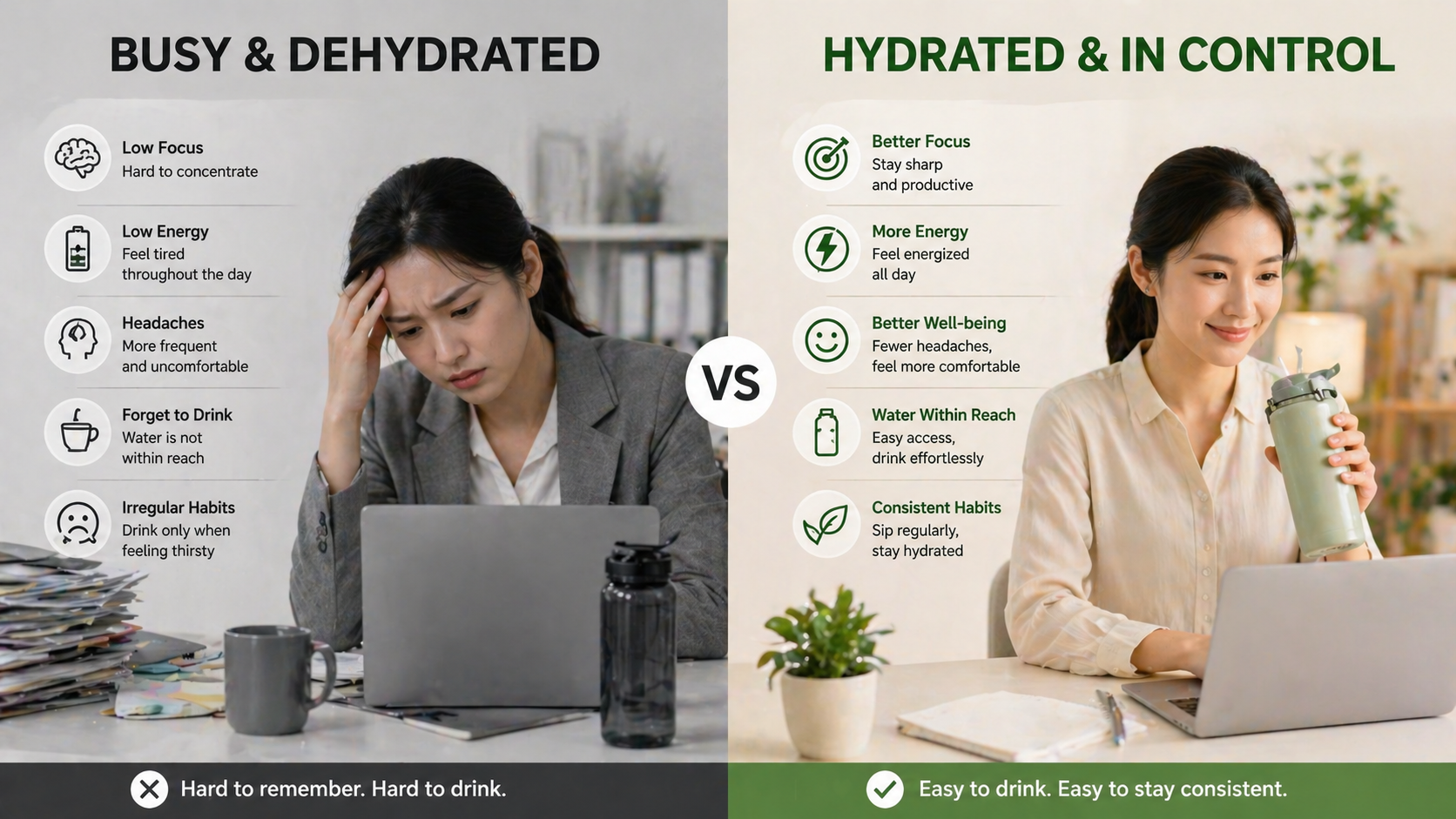
6. Real-Life Comparison: Two Different Outcomes
Person A
- Keeps bottle in bag
- Needs two hands to open
- Drinks only when very thirsty
Result:
Low hydration, inconsistent habits
Person B
- Keeps bottle within reach
- Uses an easy-access design
- Drinks frequently without thinking
Result:
Consistent hydration, better routine
Key Insight
The difference is not motivation.
It is environment and design.
7. Common Mistakes Busy People Make
- Relying on reminders but ignoring them
- Choosing inconvenient drinkware
- Drinking only when thirsty
- Treating hydration as a separate task
These approaches fail because they don’t address the real issue: friction.
8. A Simple Hydration System for Busy People
Step 1: Keep Water Within Reach
Make access effortless.
Step 2: Use Low-Friction Drinkware
Choose designs that are easy to use.
Step 3: Attach Drinking to Existing Habits
Integrate hydration into your routine.
Step 4: Focus on Consistency, Not Perfection
Small, repeated actions matter more than occasional large efforts.
9. The Bigger Insight: Hydration Is About Design, Not Discipline
The common belief is:
“I need to try harder.”
But the more accurate perspective is:
“I need a better system.”
When your environment supports hydration:
- You drink more without effort
- You stay consistent
- You don’t rely on reminders
Conclusion: You Don’t Need More Willpower—You Need Less Friction
Busy lifestyles are not going away.
Schedules will remain full. Attention will remain limited.
But hydration doesn’t need to compete with your priorities.
It needs to fit into them.
When drinking water becomes:
- Easy
- Accessible
- Automatic
It stops being something you “should do”—and becomes something you naturally do.
Busy people don’t stay dehydrated because they forget.
They stay dehydrated because their environment makes drinking water harder than it needs to be.
Fix the environment—and hydration follows.