
I. Introduction: The Appeal and the Reality of Glass Water Bottles
Glass water bottles occupy a unique position in the drinkware market. They are often perceived as the most “pure” option—chemically inert, visually clean, and closely associated with quality and transparency. In recent years, interest in glass bottles has increased alongside broader conversations about materials, sustainability, and taste neutrality.
However, popularity does not automatically equal suitability. While glass bottles perform exceptionally well in certain environments, they introduce clear limitations in others. Unlike plastic or stainless steel, glass has very specific mechanical properties that influence how it behaves during daily use.
This article takes a practical, evidence-based approach to glass water bottles. Instead of framing glass as superior or inferior, it examines where glass bottles genuinely excel and where they introduce trade-offs. The goal is not to promote a single material choice, but to help users make context-aware decisions grounded in real-world usage.
II. What Makes Glass Different from Other Bottle Materials
Glass is fundamentally different from plastics and metals at a material level. It is an amorphous solid—rigid, non-porous, and chemically stable. Unlike polymers, it does not soften gradually with heat, and unlike metals, it does not conduct heat efficiently or deform under stress.
From a structural perspective, glass has high compressive strength but low tensile strength. This means it performs well under uniform pressure but poorly under impact or point loads. When glass fails, it does so suddenly rather than gradually.
Protective sleeves and silicone housings are often used to mitigate these weaknesses, but they do not change the underlying behavior of the material. They reduce surface damage and improve grip, but they cannot eliminate brittleness.
This contrast explains why glass bottles feel premium and stable in calm environments but risky in dynamic ones.
III. Taste Neutrality and Chemical Stability
One of the strongest arguments in favor of glass water bottles is taste neutrality. Glass is chemically inert under normal drinking conditions, meaning it does not react with water, acids, or flavor compounds.
Laboratory tests comparing material interactions show that glass exhibits near-zero flavor absorption, even after prolonged exposure to acidic or aromatic liquids. In contrast, plastics—especially those with micro-scratches—can retain trace odors over time.
For users highly sensitive to taste, this difference is noticeable. Coffee, citrus water, and flavored beverages leave no residual aroma in glass bottles once properly cleaned. This makes glass particularly appealing for users who rotate between different drinks.
However, it is important to note that taste sensitivity varies widely. For many daily users who drink only water, the difference between glass and high-quality plastic may be functionally negligible.
Taste neutrality matters most in multi-beverage use cases and for users with heightened sensory sensitivity.
IV. Health and Safety Considerations
Glass is often described as “safe” because it does not leach substances into liquids under normal conditions. This is accurate—but incomplete.
From a chemical standpoint, glass is among the most stable materials used in food and beverage storage. It does not degrade, migrate, or interact with contents over time.
From a physical safety standpoint, glass introduces other risks. Breakage is the primary concern. When glass bottles fail, they can produce sharp fragments capable of causing injury.
Thermal shock is another factor. Sudden temperature changes—such as adding hot liquid to a cold bottle—can cause cracking or shattering due to uneven expansion. This risk increases in thinner-walled bottles.
Protective sleeves reduce injury risk by containing fragments, but they do not prevent breakage. In environments involving movement, children, or shared spaces, this trade-off becomes significant.
Safety, therefore, must be evaluated holistically: chemical stability versus physical risk.
V. Weight, Fragility, and Portability Trade-offs
Glass bottles are heavy relative to plastic. A typical 500 ml glass bottle weighs between 300 and 500 grams empty. Filled, total weight often exceeds 800 grams. Comparable plastic bottles may weigh less than half of that.
Weight directly influences carrying behavior. Behavioral studies show that users are less likely to carry heavier bottles consistently, especially during commuting or travel. Even small increases in weight reduce compliance over time.
Fragility compounds this issue. Users subconsciously modify their behavior to protect glass bottles—placing them carefully, avoiding certain bags, or leaving them behind during active days.
This protective behavior introduces friction. Over time, items that require extra attention are used less frequently, regardless of their theoretical advantages.
Glass bottles perform best when portability demands are low and predictable.
VI. Use Cases Where Glass Water Bottles Make Sense
Glass water bottles excel in stable, low-movement environments.
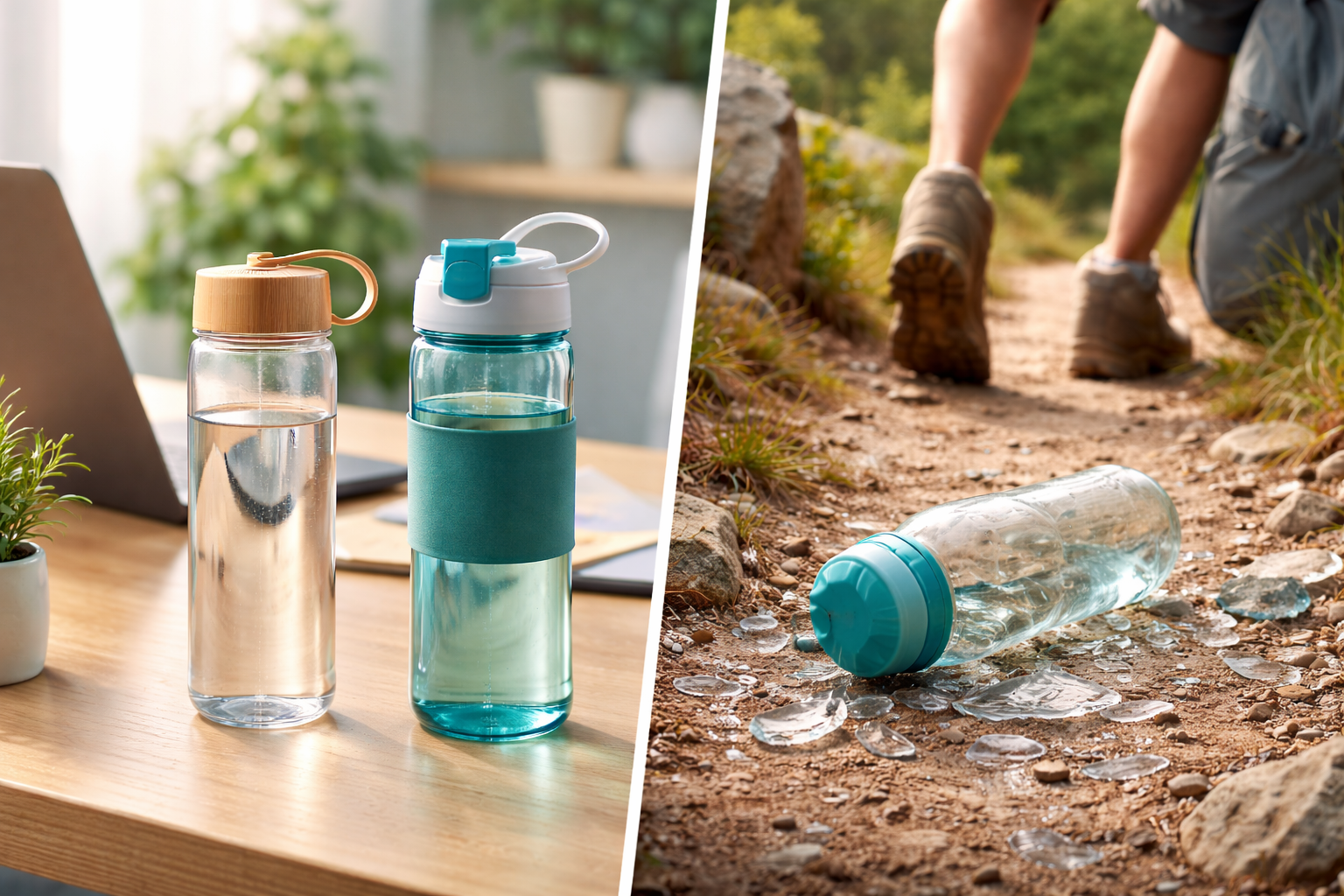
At home, glass bottles are ideal. They sit on counters or tables, are easy to clean, and provide excellent taste neutrality. In office settings, especially desk-based roles, glass bottles function well as stationary hydration tools.
Short-distance routines—such as carrying a bottle from kitchen to living room—pose minimal risk. Users focused on aesthetic consistency or minimal material interaction also benefit from glass.
Glass bottles are particularly suitable for users who:
- Drink a variety of beverages
- Value taste purity highly
- Use bottles primarily in controlled environments
- Prioritize easy visual cleanliness checks
In these scenarios, glass delivers maximum benefit with minimal downside.
VII. Situations Where Glass Bottles Are a Poor Fit
Glass bottles struggle in dynamic or unpredictable environments.
Sports and outdoor activities expose bottles to drops, impacts, and uneven surfaces. Even with sleeves, glass bottles are not designed for these conditions.
Travel and commuting introduce vibration, crowding, and limited storage control. Breakage risk increases significantly in backpacks, luggage, and public transport.
For children, glass bottles are generally unsuitable. Accidental drops and rough handling make breakage likely, increasing injury risk.
Cold environments also pose challenges. Glass is more susceptible to cracking under freezing conditions, especially when liquids expand.
In these use cases, durability and resilience outweigh taste neutrality.
VIII. Environmental Perspective: Perception vs Practical Impact
Glass is often viewed as environmentally superior because it is recyclable. While technically true, the full environmental picture is more complex.
Glass production is energy-intensive. High melting temperatures increase carbon footprint, and glass bottles are heavier to transport, increasing emissions per unit.
Breakage-related replacement also matters. A glass bottle replaced twice a year due to damage may have a higher lifecycle impact than a durable bottle used for several years.
Environmental benefit depends on actual usage patterns, not material reputation. Longevity and consistent reuse are the dominant factors.
IX. Cleaning, Maintenance, and Daily Hygiene
Glass bottles are easy to clean. Smooth, non-porous surfaces resist staining and odor retention. They tolerate high-temperature washing and most detergents.
Dishwasher compatibility is a major advantage, especially for hygiene-conscious users.
However, sleeves and seals complicate cleaning. Moisture trapped between sleeve and bottle can promote odor if not dried properly.
Maintenance effort remains low, but accessories introduce complexity.
X. Cost, Longevity, and Ownership Economics
Glass bottles typically cost more than basic plastic bottles but less than premium insulated steel bottles.
However, replacement frequency alters economics. Breakage increases total cost of ownership. Users who replace glass bottles frequently may spend more over time than those using durable alternatives.
Longevity depends heavily on environment. In controlled settings, glass bottles can last for years. In mobile lifestyles, lifespan shortens dramatically.
XI. How to Decide: A Practical Decision Framework
Choosing a glass bottle should be a lifestyle decision, not a moral one.
Glass makes sense when:
- Usage is stationary or predictable
- Taste neutrality is a priority
- Breakage risk is low
Glass is a poor choice when:
- Portability and durability matter
- The environment is dynamic
- Users cannot control handling conditions
Hybrid approaches—using glass at home and other materials outside—often deliver the best results.
XII. Conclusion: Glass Bottles Are a Tool, Not a Rule
Glass water bottles are neither universally superior nor inherently impractical. They are specialized tools that excel under the right conditions.
Understanding their material properties clarifies both their strengths and their limitations. When chosen intentionally and used in appropriate contexts, glass bottles deliver outstanding performance. When used outside those contexts, they introduce unnecessary friction and risk.
In the end, the best bottle material is not defined by trends or assumptions, but by how well it fits into real life.