
I. Introduction: “Long-Lasting” Is Not a Fixed Number
Consumers often ask a seemingly simple question: How long should a reusable water bottle last?
The reality is that there is no universal answer, and any brand that claims otherwise is oversimplifying a complex interaction between material science, usage behavior, and design constraints.
Durability is not a single number printed on a box. It is a moving target shaped by how a bottle is used, cleaned, transported, and maintained over time. Two identical bottles can have dramatically different lifespans depending on whether they live on an office desk, inside a gym bag, or clipped to a backpack during daily commuting.
This article approaches bottle lifespan from a functional durability perspective, not from health claims or regulatory limits. Instead of asking “Is this bottle still safe?”, we ask a more grounded and practical question:
Is this bottle still structurally sound, functionally reliable, and fit for its intended use?
II. The Lifespan of Reusable Water Bottles by Material
Material choice is the single strongest predictor of how long a reusable water bottle can realistically remain in service. Each material brings a different balance of strength, wear resistance, and failure modes.
Material × Expected Lifespan × Usage Scenario Comparison
| Material Type | Expected Usable Lifespan* | Typical Failure Mode | Best-Fit Usage Scenarios | Less Suitable Scenarios |
|---|---|---|---|---|
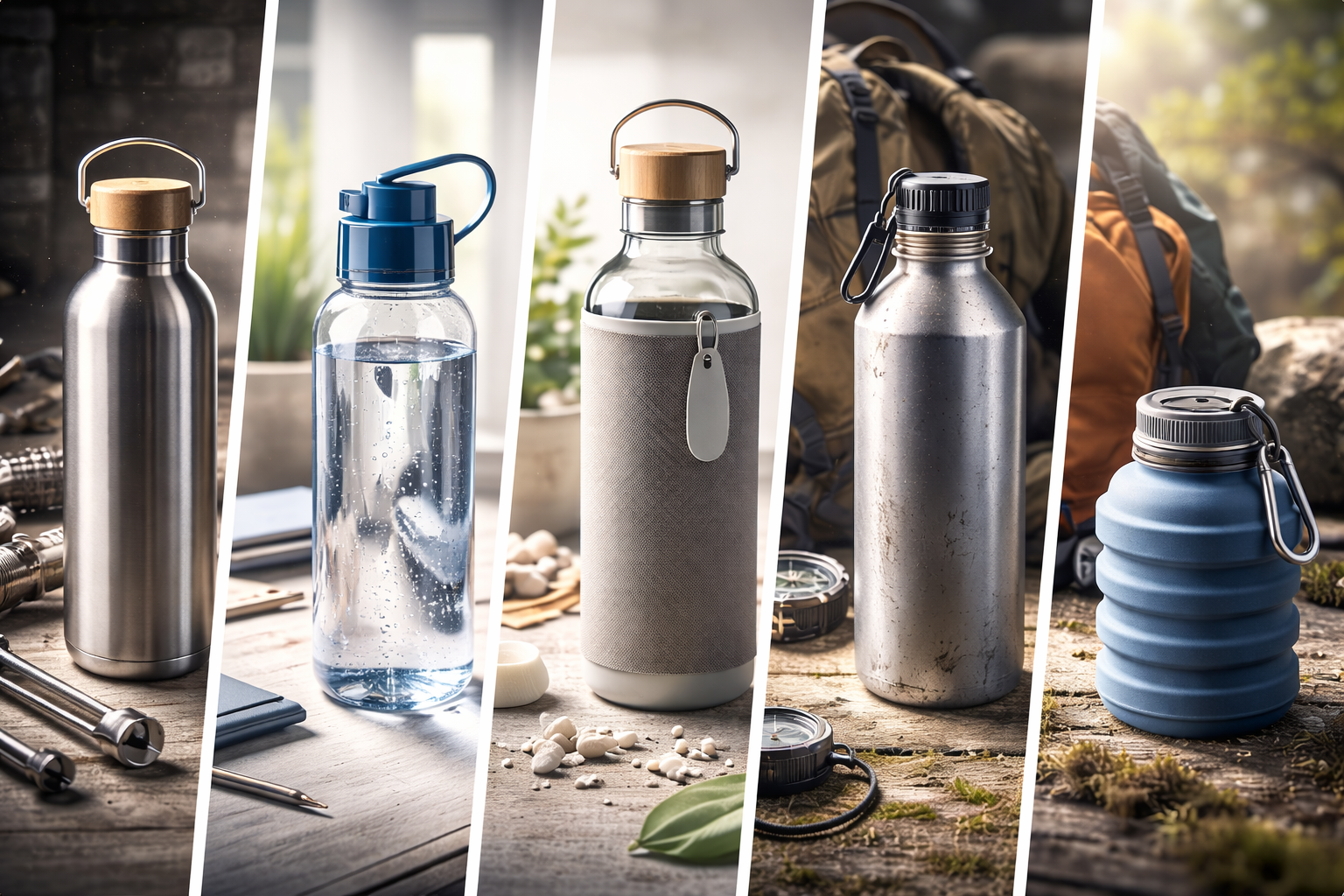
| Stainless Steel | 5–10+ years | Lid wear, seal fatigue, denting | Daily commuting, travel, outdoor use, gym | Ultralight minimalist carry |
| High-Grade Plastic (Tritan™) | 1.5–3 years | Scratching, odor retention | Office, school, short-term daily hydration | Hot liquids, long-term heavy use |
| Glass | 3–7 years (context-dependent) | Impact breakage | Home, office desk, stationary use | Travel, sports, outdoor activities |
| Aluminum (lined) | 2–4 years | Internal liner degradation | Casual daily use, lightweight carry | Long-term heavy rotation |
| Silicone / Collapsible | 1–2 years | Material fatigue, shape loss | Travel backup, hiking, space-saving needs | Primary everyday bottle |
* Expected usable lifespan assumes normal daily use, basic maintenance, and non-abusive handling. Cosmetic wear may occur earlier without affecting function.
1. Stainless Steel Water Bottles
Stainless steel bottles are widely regarded as the most durable option in the reusable bottle category, and for good reason.
From a structural standpoint, high-quality stainless steel can remain intact for many years, even under frequent daily use. Dents and surface scratches are common, but these are typically cosmetic rather than functional issues.
In real-world conditions, the usable lifespan of a stainless steel bottle often ranges from 5 to 10 years or more, assuming normal care. The bottle body itself rarely “fails” outright. Instead, end-of-life usually arrives through secondary components.
Common wear points include:
- Lids and caps developing cracks or warping
- Silicone seals losing elasticity
- Internal coatings (if present) degrading due to abrasion
In practice, many stainless steel bottles remain functional indefinitely as long as replaceable parts are available. The bottle body is often the last component to fail.
2. High-Grade Plastic Bottles (Tritan™ and Similar Materials)
High-grade plastics such as Tritan™ are designed to balance durability, transparency, and lightweight portability. They perform well in moderate-use scenarios but behave very differently from metal over time.
Plastic bottles typically exhibit gradual degradation rather than sudden failure. The most common signs of aging include:
- Micro-scratches accumulating on the inner surface
- Cloudiness or loss of visual clarity
- Odor retention after repeated use
Even when structurally intact, these surface changes can affect user perception and satisfaction. As a result, plastic bottles are often replaced for experiential reasons rather than functional necessity.
A realistic lifespan for daily-use plastic bottles is typically 1.5 to 3 years, depending heavily on cleaning methods and exposure to heat. Dishwasher use, abrasive brushes, and frequent temperature fluctuations can significantly shorten this window.
3. Glass Water Bottles
Glass occupies a unique position in the durability discussion. Chemically, it is extremely stable and does not degrade through normal liquid contact. Mechanically, however, it is inherently vulnerable.
In controlled environments—such as home or office use—a glass bottle can last for many years with minimal change in performance. However, in mobile or outdoor contexts, impact risk becomes the dominant lifespan limiter.
Protective silicone sleeves improve survivability but do not eliminate breakage risk. For this reason, glass bottle lifespan is highly context-dependent. In low-impact settings, lifespan may exceed five years. In active, on-the-go use, breakage can occur within months.
Glass bottles fail abruptly rather than gradually, making their lifespan unpredictable compared to other materials.
4. Aluminum Water Bottles
Aluminum bottles are lightweight and impact-resistant but rely heavily on internal liners to function effectively.
The aluminum shell itself can last many years, but the internal liner—often a polymer coating—defines the bottle’s usable life. Over time, liners may wear, crack, or peel due to abrasion and temperature stress.
Once liner integrity is compromised, the bottle typically reaches end-of-life regardless of external condition. As a result, aluminum bottles often have a practical lifespan of 2 to 4 years, depending on liner quality and usage patterns.
5. Silicone and Collapsible Bottles
Silicone bottles are engineered for flexibility and portability rather than maximum lifespan. Their durability challenges are less visible but equally real.
Repeated folding and stretching introduces material fatigue over time. While silicone resists cracking better than rigid plastics, it can lose shape memory and sealing precision.
Collapsible bottles are best viewed as purpose-specific tools rather than long-term primary hydration vessels. Their typical replacement cycle ranges from 1 to 2 years under regular use.
III. What Factors Actually Determine How Long a Bottle Lasts
Material sets the ceiling, but usage determines the outcome. Several real-world variables dramatically influence lifespan.
1. Usage Frequency and Intensity
A bottle used occasionally will age very differently from one used multiple times daily. Constant transport increases exposure to drops, compression, and vibration.
High-intensity use accelerates wear on lids, threads, and seals, regardless of material quality.
2. Cleaning Habits and Maintenance Style
Cleaning is essential, but over-cleaning can be as damaging as neglect.
Frequent dishwasher cycles expose bottles to:
- Prolonged heat
- Strong detergents
- Mechanical agitation
These factors disproportionately affect plastics, seals, and coatings. Gentle hand washing with non-abrasive tools often extends lifespan significantly.
3. Temperature Exposure and Thermal Stress
Rapid temperature changes introduce internal stress, especially in plastics and coated metals. Freezing liquids, pouring boiling water, or cycling between extremes accelerates micro-damage.
Metal bottles handle temperature variation better structurally, but lids and seals remain vulnerable.
4. Lid, Seal, and Accessory Wear
In most cases, bottles are retired not because the body fails, but because they leak.
Threads wear down, silicone gaskets lose elasticity, and flip mechanisms weaken. Bottles designed with replaceable components consistently achieve longer service lives.
5. Storage and Carrying Environment
Bottles carried in backpacks or vehicle cup holders face constant friction and impact. Over time, small stresses accumulate into functional issues.
Storage conditions—such as prolonged exposure to heat inside cars—also accelerate material aging.
IV. When Is a Reusable Water Bottle “Used Up”?
A bottle is not obsolete simply because it looks worn.
Scratches, dents, and faded finishes are primarily cosmetic. True end-of-life indicators are functional:
- Persistent leaks
- Structural cracks
- Deformed threads preventing proper sealing
Understanding this distinction helps prevent premature replacement.
V. Durability, Sustainability, and Replacement Cycles
From a sustainability standpoint, lifespan matters more than material alone.
A durable bottle used for eight years offsets far more single-use containers than multiple short-lived alternatives. Durability acts as a multiplier, amplifying the environmental value of reuse.
Frequent replacement undermines even well-intentioned sustainable choices.
VI. Cost Per Year: A More Practical Way to Measure Value
Rather than comparing sticker prices, lifespan allows for a clearer metric: cost per year of use.
A higher-priced bottle that lasts eight years often costs less annually than a cheaper option replaced every twelve months. This framing aligns durability with rational purchasing rather than emotional branding.
VII. Setting Realistic Expectations: How Long Should It Last?
No bottle lasts forever, but expectations should align with material and use.
Durability is not only a design responsibility; it is a shared outcome shaped by ownership behavior. Choosing the right bottle for the right context matters as much as the bottle itself.
VIII. Conclusion: Durability Is About Fewer, Smarter Replacements
The question is not how long a reusable water bottle can last in theory, but how long it remains fit for your actual life.
Durability is best understood as a balance between material capability, design choices, and daily habits. When these elements align, reusable bottles deliver their true value: fewer replacements, lower long-term cost, and sustained usability over time.
Understanding lifespan leads not just to better products, but to better decisions.