
Choosing a water bottle should be simple. Yet for many people, it has become surprisingly complicated.
A quick search online or a short walk through any modern shopping mall in Kuala Lumpur, Jakarta, or any major Southeast Asian city will immediately show how many options now exist. There are insulated stainless steel tumblers, lightweight plastic sports bottles, glass bottles for home use, ceramic-lined coffee tumblers, collapsible travel bottles, and increasingly popular dual-lid designs that combine multiple drinking modes in one product.
At first glance, more options should make it easier to find the right one.
In reality, the opposite often happens.
Many people end up choosing a bottle based on appearance, impulse, or brand familiarity, only to stop using it a few weeks later. The issue is rarely the product itself. More often, the bottle simply does not match the way the user actually lives.
The best water bottle is not necessarily the one with the most features, the highest price, or the most attractive design.
The best water bottle is the one that naturally fits into your daily routine and makes hydration easier without effort.
This article will help you understand the main types of water bottles available today, how they differ, what scenarios they work best for, and how to choose one that truly aligns with your lifestyle in 2026.
Why Choosing the Right Water Bottle Matters More Than Ever
Modern life has changed the way people drink water.
In the past, hydration often happened at fixed times and in fixed places—at home, at work, or during meals.
Today, life is more mobile.
People commute longer distances, work in hybrid environments, travel frequently, exercise more consciously, and carry personal essentials throughout the day.
This has transformed water bottles from simple containers into everyday utility tools.
A good bottle now needs to support:
- commuting
- office work
- gym routines
- travel
- home hydration
- coffee and tea consumption
- long outdoor hours in tropical weather
In hot and humid climates such as Malaysia and Indonesia, where daily temperatures often remain high throughout the year, hydration tools become even more relevant as part of daily living.
This is why choosing the right bottle is no longer just about material.
It is about behavioral fit.
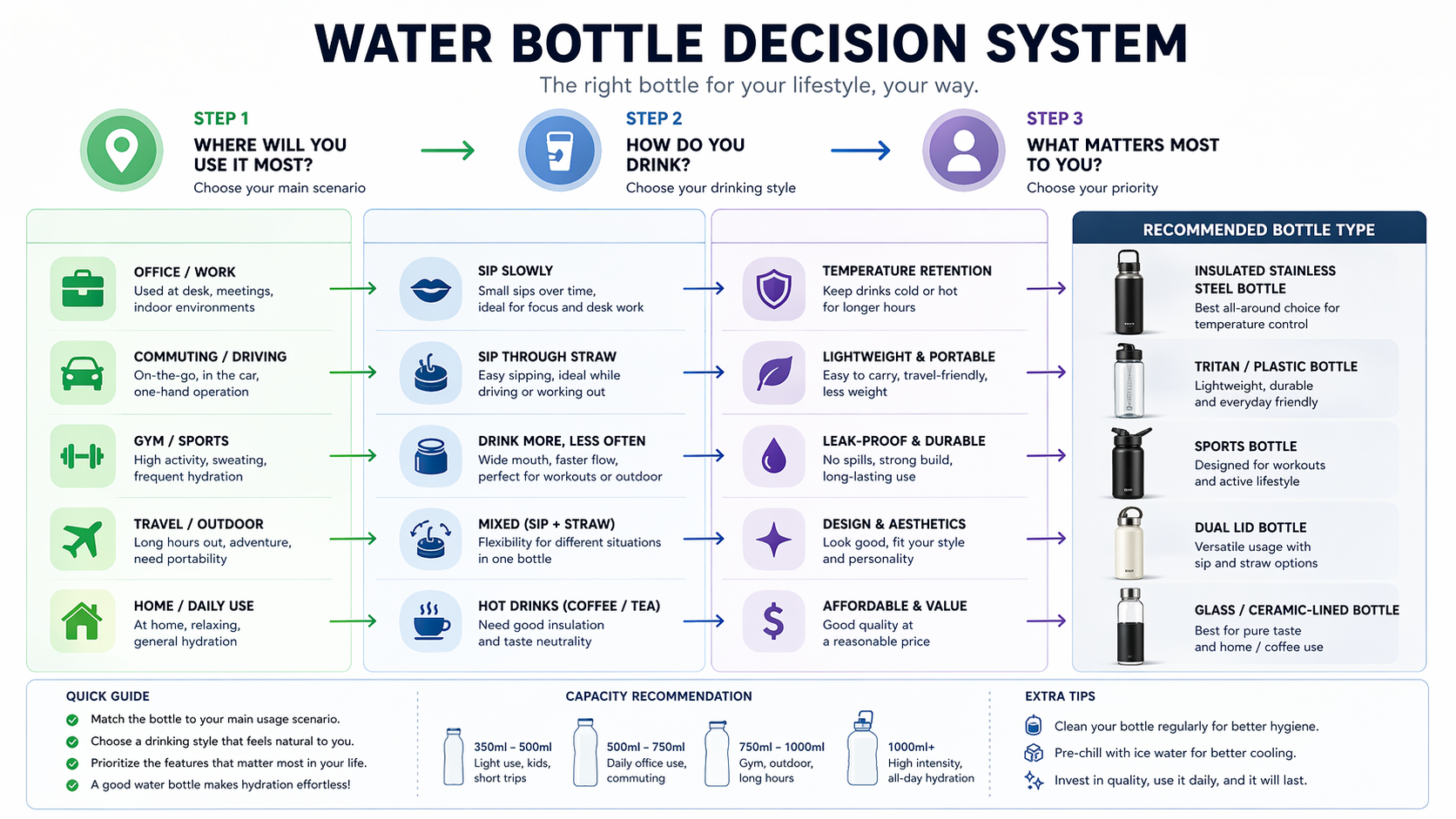
The 3 Factors That Matter Before Choosing Any Bottle
Before looking at product categories, it is important to start with the decision framework.
Most people choose bottles from the outside in.
A better method is to choose from the inside out.
Start with how you live.
1. Usage Scenario
Ask yourself:
Where will you actually use this bottle most often?
Different environments require different designs.
For example:
Office and desk use
You may prioritize:
- clean aesthetics
- moderate size (500–750ml)
- leak-proof confidence
- easy one-hand access
Commuting and driving
You may need:
- cup-holder compatibility
- one-hand opening
- straw lid or flip lid
- no spill risk
Gym and outdoor activity
Focus on:
- large capacity
- lightweight portability
- quick drinking access
- durable construction
Home use
Priorities may include:
- visual design
- easy cleaning
- compatibility with hot and cold drinks
Understanding usage scenarios immediately narrows down your options.
2. Drinking Behavior
This is one of the most overlooked factors.
People drink differently.
Some prefer slow sipping throughout the day.
Others drink larger amounts at once.
Your bottle should match your natural drinking style.
Examples:
- sip drinkers → narrow spout / coffee-style lids
- chug drinkers → wide mouth bottles
- frequent small intake → straw lid
- mixed usage → dual-lid design
3. Lifestyle Fit
A bottle should support the way you already live.
Examples:
Minimalist users
Prefer:
- one bottle for all scenarios
- durable long-term use
- simple structure
Active users
Prefer:
- larger volume
- ergonomic grip
- impact resistance
Style-conscious users
Prefer:
- premium finishes
- modern colors
- personalized details
Once these three factors are clear, choosing bottle types becomes much easier.
The Main Types of Water Bottles Explained
Now let’s break down the major categories.
1. Plastic Water Bottles
Plastic bottles remain one of the most common types in the market.
They are popular because they are:
- lightweight
- affordable
- easy to carry
- widely available
Modern reusable plastic bottles are often made from BPA-free materials.
However, not all plastic bottles are equal.
Best For
- sports
- short commutes
- casual daily use
- students
Advantages
- lightweight
- lower cost
- easy portability
- wide style variety
Limitations
- weaker temperature retention
- may absorb odor over time
- shorter lifespan compared to steel
For users who prioritize mobility and affordability, plastic remains practical.
For long-term daily use, many consumers now move toward upgraded materials.
2. Tritan Bottles
Tritan deserves its own category because it has become increasingly popular in recent years.
Tritan is a high-performance plastic known for:
- clarity
- durability
- odor resistance
- BPA-free safety positioning
It offers the lightweight advantage of plastic with improved user experience.
Best For
- office use
- casual hydration
- aesthetic transparent designs
Why It’s Trending
Consumers increasingly prefer materials that feel premium without the weight of metal or glass.
Tritan sits in that middle ground.
3. Stainless Steel Bottles
This is currently one of the strongest product categories in modern drinkware.
Especially for everyday carry, insulated stainless steel bottles dominate.
Single-Wall Stainless Steel
These are simpler and lighter.
Best for:
- room-temperature drinks
- outdoor durability
- long-term resilience
Vacuum Insulated Stainless Steel
This is the mainstream premium category.
These bottles use double-wall vacuum insulation.
This structure helps maintain drink temperature for extended periods.
Best For
- office workers
- commuters
- daily carry
- tropical weather use
Advantages
- excellent temperature retention
- durability
- long-term value
- premium feel
For most users in 2026, this remains the most practical category.
4. Glass Water Bottles
Glass bottles serve a different kind of consumer need.
They are often chosen for taste purity and visual clarity.
Many people feel water tastes “cleaner” in glass.
Best For
- home
- office desk use
- tea and infused drinks
Advantages
- neutral taste
- visually elegant
- easy to clean
Limitations
- heavier
- breakable
- less portable
Glass works best in stable indoor environments.
5. Ceramic-Lined Bottles
This is one of the strongest modern premium trends.
Ceramic-lined stainless steel bottles combine:
- temperature insulation
- taste neutrality
- reduced metallic aftertaste
They are especially popular among coffee and tea drinkers.
Best For
- coffee
- tea
- premium lifestyle drinkware
Why It Matters
Many users dislike the metallic taste sometimes associated with steel interiors.
Ceramic lining improves drinking experience significantly.
6. Collapsible Silicone Bottles
This category is driven by portability.
These bottles are ideal for travel.
Best For
- travel
- hiking
- flexible storage
Advantages
- compressible
- lightweight
- space-saving
Limitations
- less premium feel
- weaker structure
7. Sports Bottles and Large Capacity Bottles
This category continues to grow.
1L and above bottles are increasingly common.
Why Bigger Bottles Are Trending
Modern consumers want fewer refills.
Larger bottles support:
- long workdays
- gym sessions
- long commutes
This is particularly relevant in tropical Southeast Asia.
Lid Design Matters More Than Most People Think
Many people focus only on bottle material.
In reality, lid design often has a bigger impact on daily satisfaction.
Screw Cap
Best for:
- secure sealing
- travel
Less convenient for frequent use.
Flip Lid
Good for:
- office
- commuting
Fast access.
Straw Lid
Excellent for:
- driving
- gym
- frequent sipping
Dual-Lid Design
This is one of the most important modern trends.
Dual-lid bottles combine:
- straw opening
- sip opening
This allows different drinking styles in one product.
For example:
- straw for driving
- sip opening for hot coffee
This improves versatility significantly.
Modern Drinkware Trends in 2026
The market is clearly moving in several directions.
1. Larger Capacity
Consumers increasingly prefer:
- 900ml
- 1L
- 1.2L
This supports all-day hydration.
2. Multi-Function Lids
Dual-use lids are becoming standard in premium categories.
3. Personal Aesthetics
Drinkware is now part of personal style.
Colors, textures, and finishes matter more than before.
4. Lifestyle Integration
Products are increasingly designed around scenarios.
For example:
- desk tumblers
- car tumblers
- gym bottles
Common Mistakes People Make When Choosing Bottles
Mistake 1: Buying Based on Looks Alone
Aesthetic value matters.
But design should never replace usability.
Mistake 2: Choosing the Wrong Size
Too large → inconvenient
Too small → constant refills
Mistake 3: Ignoring Lid Type
The wrong lid quickly becomes frustrating.
Mistake 4: Buying Too Many Bottles
Often one well-chosen bottle performs better than several average ones.
A Simple Buying Guide
Use this framework.
If you work in an office
Choose:
- 600–750ml
- insulated
- flip lid or dual lid
If you commute daily
Choose:
- cup-holder friendly
- straw lid
- leak-proof
If you go to the gym
Choose:
- 1L+
- lightweight
- quick access lid
If you mainly stay at home
Choose:
- glass or ceramic-lined
- design-forward
Final Thoughts
The best water bottle is not defined by marketing language.
It is defined by how naturally it fits into your life.
A bottle should reduce effort, not create it.
It should make hydration feel automatic.
Because in the end, the right bottle is not the one with the most features.
It is the one you reach for every single day.