
In today’s world of everyday products, few items are used as frequently—and as casually overlooked—as the insulated bottle.
Most people think of it as a simple container: something that keeps drinks hot or cold for a few hours. But this view misses the bigger picture.
An insulated bottle is not just a container.
It is a functional system—engineered to manage temperature, improve usability, and support daily habits across different environments.
From morning coffee at your desk to hydration during long commutes or outdoor activities in tropical climates, a well-designed insulated bottle plays a quiet but essential role in modern life.
This guide breaks down what an insulated bottle really is, how it works, what materials and structures define its performance, and how to choose one that fits your lifestyle in 2026.
Why Insulated Bottles Matter More Today
Modern life has changed how and where we consume beverages.
We no longer drink only at fixed places like home or cafés. Instead, hydration happens:
- during commutes
- at workstations
- at the gym
- while traveling
- in outdoor environments
In regions like Southeast Asia, where high temperatures and humidity are part of daily life, temperature control becomes even more important. Cold drinks warm up quickly, and hot beverages cool down faster than expected.
This shift has turned insulated bottles into everyday performance tools, not just accessories.
What Is an Insulated Bottle?
At its most basic level, an insulated bottle is designed to slow down heat transfer between the liquid inside and the external environment.
It does not create heat or cold.
Instead, it preserves the temperature of what you put inside.
Basic Definition
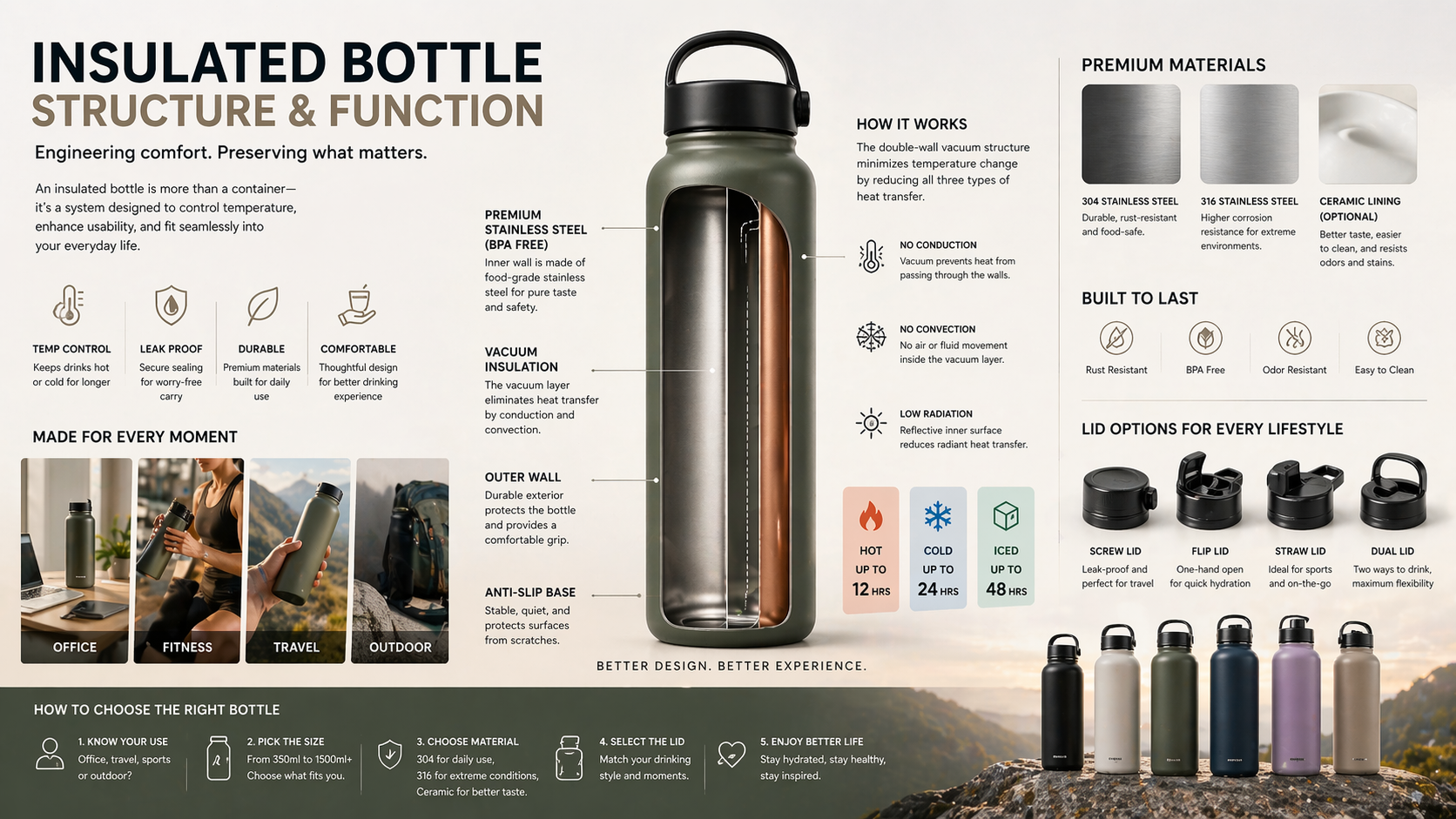
An insulated bottle typically consists of:
- a double-wall structure
- a vacuum layer between the walls
- a sealed lid system
How It Differs from Regular Bottles
| Feature | Regular Bottle | Insulated Bottle |
|---|---|---|
| Structure | Single wall | Double wall |
| Function | Holds liquid | Controls temperature |
| Usage time | Short-term | Extended duration |
Core Principle
The goal is simple:
Reduce heat transfer through conduction, convection, and radiation.
This is achieved through structure—not just material.
The Core Structure of an Insulated Bottle
To understand performance, you need to understand structure.
1. Double-Wall Construction
This is the foundation of every insulated bottle.
Instead of a single layer, the bottle has:
- an inner wall (in contact with the liquid)
- an outer wall (exposed to the environment)
This separation reduces direct heat transfer.
2. Vacuum Insulation Layer
Between the two walls is a vacuum.
A vacuum contains almost no air, which means:
- minimal heat conduction
- no convection
This dramatically slows down temperature exchange.
3. Inner Lining (Liquid Contact Surface)
The inner wall is critical because it directly affects:
- taste
- safety
- durability
Common designs include:
- standard stainless steel interiors
- ceramic-lined interiors (increasingly popular)
4. Lid System (Often Overlooked)
Many people focus on the bottle body and ignore the lid.
This is a mistake.
The lid is one of the biggest points of heat loss.
A well-designed lid must:
- seal tightly
- minimize air exchange
- support easy use
5. Sealing Components
These include:
- silicone gaskets
- threaded closures
- pressure seals
Poor sealing leads to:
- temperature loss
- leakage
- poor user experience
Materials: What Your Bottle Is Really Made Of
Material choice defines durability, safety, and long-term performance.
1. Stainless Steel (Industry Standard)
Most insulated bottles use food-grade stainless steel.
304 Stainless Steel
- widely used
- corrosion-resistant
- cost-effective
316 Stainless Steel
- higher resistance to corrosion
- better for harsh environments (e.g., salty or acidic conditions)
Often considered a premium upgrade.
2. Ceramic-Lined Interiors (Modern Upgrade)
This is one of the most important recent developments.
A thin ceramic coating is applied to the inner wall.
Benefits:
- neutral taste (no metallic aftertaste)
- better for coffee and tea
- improved user experience
Trade-Off:
- slightly higher cost
- requires precise manufacturing
3. Exterior Materials and Coatings
The outer layer affects:
- grip
- durability
- visual appeal
Common finishes include:
Powder Coating
- matte texture
- anti-slip
- scratch-resistant
Gloss Finish
- smooth
- visually striking
Specialty Coatings
- gradient colors
- UV printing
- textured finishes
These contribute to both function and brand identity.
Performance: What Actually Matters
Consumers often focus on marketing claims.
A better approach is to understand real performance factors.
1. Heat Retention
Measured in hours (e.g., 6h, 12h, 24h).
But context matters:
- starting temperature
- ambient conditions
- lid usage
2. Cold Retention
In tropical regions, this is often more important than heat retention.
A good insulated bottle should:
- keep water cool for extended periods
- reduce condensation
3. Leak-Proof Reliability
This is not optional.
A good bottle must:
- seal completely
- handle movement (bags, travel, commuting)
4. Durability
Daily use involves:
- drops
- scratches
- repeated opening/closing
Durability ensures long-term value.
The Role of Design in Everyday Use
Performance alone is not enough.
A bottle must also be easy to use.
1. Drinking Experience
This includes:
- flow rate
- comfort of opening
- ease of use
2. Lid Types
Different lids serve different purposes:
Screw Lid
- secure
- best for travel
Flip Lid
- convenient
- quick access
Straw Lid
- ideal for driving or active use
Dual-Lid Design (Emerging Standard)
Combines:
- straw drinking
- direct sip opening
This allows flexibility across scenarios.
3. Weight and Balance
A bottle should feel stable:
- not too heavy
- not too top-heavy
Good balance improves daily usability.
Modern Trends in Insulated Bottles (2025–2026)
The category is evolving.
1. Multi-Functional Designs
Products are no longer single-purpose.
They adapt to:
- work
- travel
- exercise
2. Larger Capacity
1L and above bottles are increasingly common.
They reduce refill frequency.
3. Aesthetic Integration
Drinkware is now part of personal style.
Design matters as much as function.
4. Experience-Focused Engineering
Brands are focusing more on:
- usability
- feel
- daily interaction
Common Mistakes When Choosing an Insulated Bottle
Mistake 1: Only Looking at Temperature Claims
Real-world use depends on more than numbers.
Mistake 2: Ignoring Lid Design
The lid defines daily experience.
Mistake 3: Choosing Based Only on Appearance
Good design is not just visual—it’s functional.
Mistake 4: Not Matching Lifestyle Needs
A gym bottle is different from an office bottle.
How to Choose the Right Insulated Bottle
Use this simple framework.
Step 1: Define Your Primary Use
- office
- commuting
- travel
- fitness
Step 2: Choose the Right Capacity
- 500–700ml → daily carry
- 700–1000ml → extended use
- 1L+ → long days
Step 3: Select Material
- 304 → standard
- 316 → premium
- ceramic-lined → best taste
Step 4: Pick the Right Lid
Match your drinking behavior.
Step 5: Evaluate Build Quality
Check:
- sealing
- coating
- weight
Brand Perspective: Why Details Matter
At a glance, many insulated bottles look similar.
But real differences lie in details.
1. Good Design Feels Invisible
The best bottle:
- doesn’t leak
- doesn’t require effort
- doesn’t interrupt your routine
2. Built for Daily Life
High-frequency products must:
- be reliable
- be consistent
- be easy to use
3. Small Details Define Quality
- smooth threading
- precise seals
- balanced weight
- durable coating
These are not marketing features.
They are real-world performance factors.
Conclusion
An insulated bottle is more than a tool for keeping drinks hot or cold.
It is a product designed to support daily behavior.
When chosen well, it:
- improves hydration habits
- enhances comfort
- integrates seamlessly into your lifestyle
When chosen poorly, it becomes another unused object.
The difference is not in the label or the marketing.
It is in how well the bottle aligns with how you actually live.
Because in the end, the best insulated bottle is not the one with the most features.
It is the one you use—every single day.