
Introduction: Performance Is Always a Trade-Off
In product design, performance is rarely about maximizing a single feature. It is about choosing the right balance for real-world use. Insulation, durability, capacity, and weight all compete for priority, and improving one often comes at the expense of another.
In drinkware, insulation has become the dominant selling point. Longer heat retention times, thicker walls, and more complex structures are widely marketed as universal improvements. Yet in practice, insulation is not always the deciding factor that determines whether a bottle is actually used.
There are many everyday situations where weight matters more than insulation. In these contexts, a lighter bottle is not a compromise—it is the better tool for the job.
Understanding Weight vs Insulation in Bottle Design
What Adds Weight to Insulated Bottles
Insulated bottles gain weight primarily from structure. Double-wall construction, vacuum chambers, thicker stainless steel liners, and reinforced bases all contribute to mass. These elements are essential for long-term thermal retention, but they are not weight-neutral.
As insulation performance increases, so does the material volume required to support it. Even small increases in wall thickness or structural reinforcement can significantly change how a bottle feels when carried for extended periods.
What Lightweight Bottles Give Up
Lightweight bottles typically reduce or eliminate these structural layers. This does not mean they abandon temperature control entirely. Instead, they trade long-duration insulation for reduced mass and improved portability.
What is given up is not function, but time. A lightweight bottle may keep a drink cool or warm for an hour instead of six. In many scenarios, that difference is inconsequential.
Real-World Use Cases Where Lightweight Wins
Daily Commute and Short Trips
Most daily commutes last less than an hour. During this time frame, beverages rarely experience dramatic temperature changes, especially in moderate indoor environments.
Carrying a heavy insulated bottle during a commute introduces unnecessary bulk without delivering meaningful benefits. A lighter bottle is easier to handle, easier to store, and less likely to be left behind.
In this context, insulation beyond a basic level provides diminishing returns.
Travel and Carry-On Constraints
When traveling, weight compounds quickly. Luggage restrictions, backpack capacity, and long walking distances amplify the cost of every extra gram.
A lightweight bottle reduces fatigue and frees capacity for more essential items. For travelers who frequently refill their bottles, long-term insulation becomes less critical than ease of carry and quick access.
Sports and Active Lifestyles
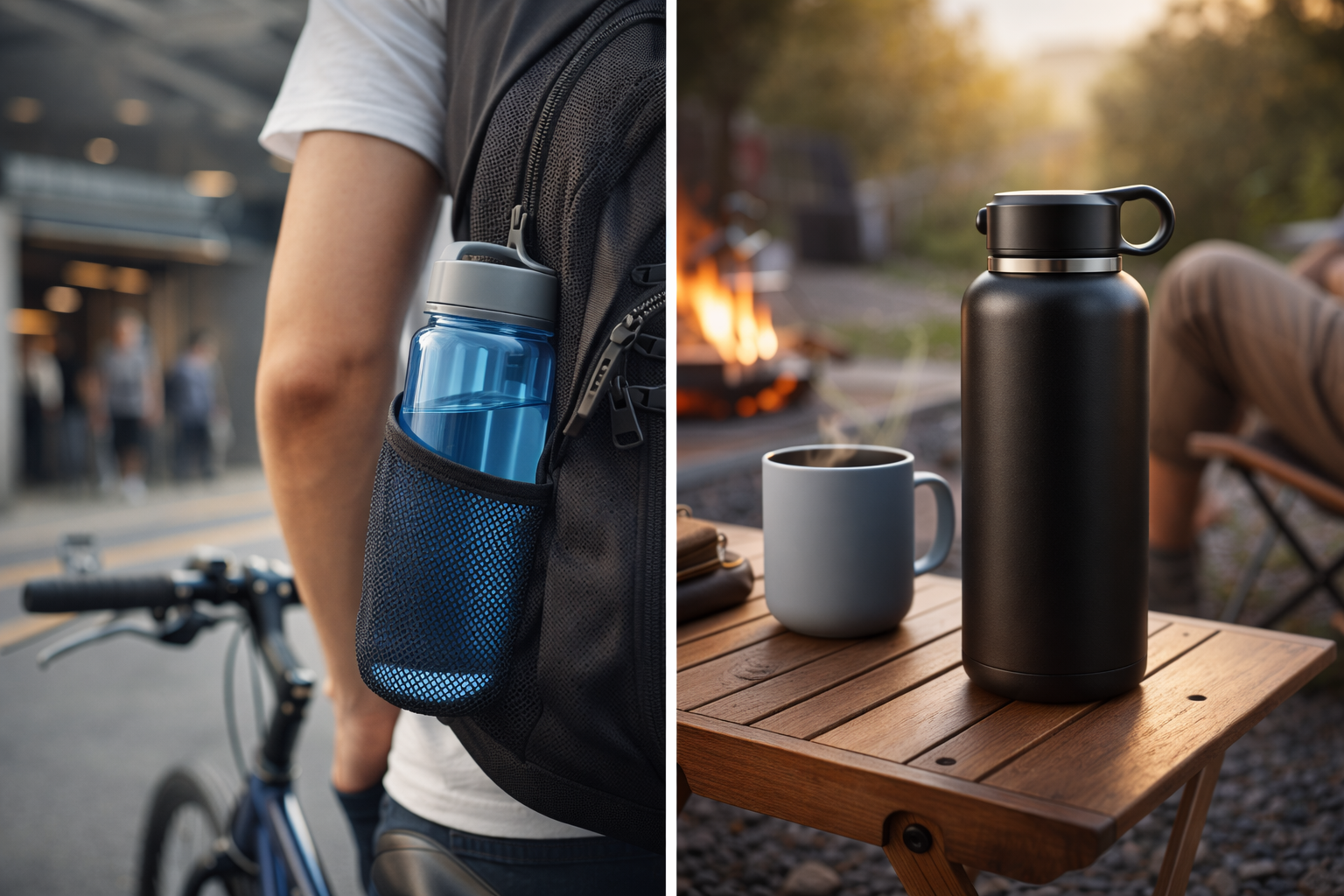
In running, cycling, hiking, and gym settings, weight sensitivity is extreme. Athletes prioritize balance, grip, and mobility over extended temperature retention.
A heavy bottle can disrupt movement, cause discomfort, or simply be impractical to carry. In these scenarios, hydration frequency matters more than beverage temperature.
Lightweight bottles align better with dynamic use patterns.
Kids and Youth Use
Children experience weight differently than adults. A bottle that feels manageable to an adult may be uncomfortable or unusable for a child.
Lightweight designs improve usability, reduce drop risk, and encourage consistent hydration. Insulation is secondary to comfort, grip, and ease of handling.
The Hidden Costs of Over-Insulation
Fatigue and Carry Discomfort
Weight is cumulative. Over the course of a day, even a small increase in carried load can lead to noticeable fatigue.
A bottle designed for maximum insulation may perform exceptionally on a lab test but fail in everyday use if it becomes a burden to carry.
Overengineering for Short Use Cycles
Many insulated bottles are designed for extreme scenarios that users rarely encounter. If a bottle is used for short intervals, such as meetings, workouts, or errands, extended insulation capacity remains unused.
This mismatch between design intent and actual behavior results in unnecessary complexity.
Space and Capacity Trade-Offs
Insulation structures occupy internal volume. For a given external size, a heavily insulated bottle often holds less liquid than a lighter design.
Users may end up carrying more weight while getting less usable capacity.
Field Observations and User Feedback: What Real Usage Reveals
Beyond design theory and laboratory assumptions, the question of weight versus insulation has been repeatedly examined through real-world testing and user discussion. Across independent temperature retention tests, product comparisons, and long-term user feedback, a consistent pattern emerges: insulation performance only becomes decisive when usage duration crosses a certain threshold.
In informal time-based tests commonly shared online, users often compare insulated bottles and lightweight single-wall bottles over short intervals—commutes, workouts, or casual outings lasting one to two hours. In these scenarios, measured temperature differences are present but modest. Many users report that beverages remain “acceptable” rather than “optimal,” which, in practice, is sufficient for most daily routines.
More revealing than temperature data, however, are usage behaviors documented through reviews and discussion threads. A recurring theme appears in long-term ownership feedback: heavier insulated bottles are more likely to be left behind. Users describe consciously switching to lighter bottles for errands, travel days, or exercise, even when they own high-performance insulated options. The decision is rarely framed as a rejection of insulation itself, but rather as a response to inconvenience.
User-generated comparisons often highlight fatigue and portability over technical metrics. In multi-day travel reports and outdoor activity logs, lighter bottles are frequently described as “the one I actually carried,” while insulated bottles are praised for performance but criticized for bulk. This distinction matters, because a bottle’s real-world effectiveness depends not only on how well it performs thermally, but on whether it is consistently used.
Community discussions also reveal a gradual recalibration of expectations. Rather than asking how long a bottle can keep drinks hot or cold, many users shift toward asking how long they realistically need that performance. In these conversations, insulation is increasingly treated as a situational feature rather than a universal requirement.
Taken together, these observations suggest that the lightweight-versus-insulation debate is not theoretical. It is shaped by repeated, distributed experimentation carried out by everyday users across different environments. The convergence of informal testing, long-term reviews, and behavior-driven choices reinforces the central argument of this article: insulation delivers value only when it aligns with actual usage patterns, and in many cases, reduced weight proves to be the more meaningful performance advantage.
Thermal Reality: When Insulation Is Marginal
Temperature Plateaus in Short Time Frames
Heat transfer is not linear. During the first hour, temperature changes are often modest, even in non-insulated containers.
For short-duration use, the difference between single-wall and insulated designs may be negligible in practical terms.
Environmental Context Matters
Indoor environments, shaded areas, and moderate climates reduce the thermal load on a bottle. In such settings, insulation offers limited advantage.
Understanding context helps avoid overestimating insulation needs.
Material Choices for Lightweight Performance
Tritan and Lightweight Plastics
Modern plastics like Tritan offer excellent strength-to-weight ratios. They resist impact, maintain clarity, and reduce overall mass.
While they lack extended insulation, they excel in portability and daily usability.
Thin-Wall Stainless Steel
Thin-wall stainless steel balances durability with reduced weight. It provides better temperature stability than plastic without the mass of double-wall designs.
This approach suits users seeking a middle ground.
Hybrid Designs
Some bottles combine lightweight materials with partial insulation. These designs target moderate performance without full structural complexity.
Hybrid approaches reflect a growing recognition that one-size-fits-all solutions rarely work.
Decision Framework: Choosing the Right Bottle for the Job
Duration vs Temperature Sensitivity
If a drink must remain hot or cold for many hours, insulation matters. If consumption occurs quickly, weight becomes more relevant.
Carry Distance vs Drink Volume
Longer carry distances increase weight sensitivity. In these cases, reducing mass often improves overall experience more than extending insulation time.
User Strength and Usage Frequency
Frequent use amplifies discomfort caused by weight. Lightweight designs are better suited for daily repetition.
Common Misconceptions About Lightweight Bottles
“Lightweight Means Low Quality”
Quality is defined by suitability. A well-designed lightweight bottle can outperform an overbuilt insulated bottle in the right context.
“No Insulation Means No Temperature Control”
All containers provide some thermal resistance. Lightweight does not mean thermally unprotected—it means optimized for a different time scale.
Design Philosophy: Matching Design to Behavior
Products succeed when they align with how people actually behave, not how they might behave in extreme cases.
Designing for real use patterns leads to better adoption, higher satisfaction, and fewer compromises.
Conclusion: The Right Tool Is the One You Carry
Insulation has value, but only when it matches the use case. A bottle that stays at home because it is too heavy delivers no performance at all.
Lightweight designs prioritize usability, mobility, and consistency. In many everyday scenarios, these qualities matter more than extended insulation.
The best bottle is not the one with the highest specifications. It is the one that fits seamlessly into daily life.